




Split Theories
We walked into the station together. The squad room buzzed with mid-shift activity, officers moving between desks, voices overlapping as cases got passed around.
Inspectors Kulkarni and Rane stood by the chai cart, laughing about something. Kulkarni spotted us first and grinned.
"Arey, Mehta! Bad luck being handed the hospital cases, haan?"
I waved an acknowledgement to him and kept walking. I'd been assigned cases like this for years, the cold cases and desk work that didn't require chasing suspects through alleys or up stairwells. Even now, it stung.
Rane turned, paper cup of chai in hand, and stepped into Desai's path. He smiled. "Desai, jump to our team. Triple homicide in Dharavi. Proper police work. We could use someone sharp."
Desai sidestepped him. "I'm sure a talented officer like you can handle it just fine, Inspector."
Rane called after us, "Offer stands, Desai! When you're getting bored playing nurse."
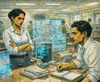
Their laughter followed us across the squad room to our adjacent desks. I dropped into my chair and accessed the case files, pulling up the medical records for all seven victims. Desai sat across from me, mouth pressed thin, already working on her recordings, and projected her interface into the air with a few gestures.
"Submitting the Tamhane interview for transcription," she said, tapping through menus. "Should have it back in a few minutes."
I sent the files to the printer in the corner. A minute later it started humming, spitting out page after page. I preferred paper when my antenna might glitch mid-read. The machine beeped when it finished and I collected the stack, the forms still warm and smelling faintly of toner, then spread them across my desk.
We worked without speaking, the silence between us comfortable but focused.
I started with victim #2, Milind Tamhane. The medical files filled in details Sarla hadn't known or couldn't articulate. Admitted to neurology with headaches and weakness, symptoms progressing rapidly. Seizures, catastrophic haemorrhage, death. And there, on a mesh compatibility assessment form dated six days before his death: Dr. Priya Iyer, Malhotra General, neurology department.
I circled the name with my pencil, then moved to victim #7, Dinesh Deshmukh, the one whose death we witnessed at the hospital yesterday. His file listed Dr. Iyer neurology consultation, mesh compatibility assessment, death in pediatric oncology ward. Just the consult, no admission, first time at Malhotra General. Two victims, same doctor, both Dr. Iyer consultations.
I flipped through the other files quickly, scanning for patterns. Victim #3, Amrita Naidu: died in neurology, Dr. Iyer consultation. Prior admission history showed multiple visits to neurology over the past year. Victim #4, Kavita Bhosale: rapid decline over one week, died in neurology, Dr. Kapadia attending. Victim #1, Mohan Joshi: died in cardiac ICU, transferred from emergency. No neurology consult, but cardiac arrest with neurological symptoms noted. Prior cardiac visits going back three years.
Victims #5 and #6 I skimmed faster. Both died in neurology. One with prior admission and one first-time patient.
All seven treated at Malhotra General. Five died in neurology, one in cardiac ICU, one in pediatric oncology. Three saw Dr. Iyer specifically.
Dr. Kapadia had handled all seven deaths, but he was the one who'd noticed the pattern and reported it. What about similar cases that other doctors hadn't flagged?
Across from me, Desai pulled up employment records, scrolling through. She paused, highlighted something, then cast a news article into the air. The headline glowed: Oberoi Pharmaceuticals Cited for Emissions Failure, Parel Plant.
She pulled up a map next, and plotted victim addresses as red dots across Mumbai. Three clustered near the Parel factory. Two more sat within what looked like a calculated exposure radius.
Ten minutes passed in focused silence. Across from me, Desai projected a chemical report, highlighting inorganic compounds. She cross-referenced them with potential industrial chemical sources.
Her projections followed her as she stood and came around to my desk. "Two confirmed Oberoi employees. Victims two and seven. Tamhane was production floor supervisor, Deshmukh worked night shift. That's quite an odd coincidence, Mehta."
I set down the file I'd been reviewing. "What about the other five?"
"I'm still pulling employment records. But look at this." She expanded the map. "Three victims lived within five hundred metres of the factory. Same municipal water loop."
"That's tens of thousands of residents. If it's water contamination, why only seven deaths?"
She waved that away. "Early days. Could be more we haven't connected yet. And the chemical reports match. Elevated rare earths and metals in all seven victims, consistent with industrial chemical exposure."
"Does Oberoi actually use those specific elements? The rare earths from the chemical reports?"
Desai paused. "I'll need to verify their chemical inventory."
"Might want to check that before we build a case around it."
She nodded. "Fair point. What's your theory, then?"
I tapped my notebook. "All seven victims were treated at Malhotra General. Three saw the same doctor, Dr. Iyer. Some kind of mesh compatibility assessment. Ever heard of that procedure?"
"Sounds like standard neurology workup," Desai said.
"I checked. It's not in any diagnostic protocol I can find."
"Three out of seven, Mehta. Less than half. Four victims never saw her at all."
"And five out of seven died in neurology. That's not random."
"One died in cardiac ICU. One in pediatric oncology. That's not a clean pattern either." She pulled up employment records. "Victim two worked at Oberoi. Victim seven too, night shift. Both with elevated rare metals. Both geographic proximity to the plant. That's what we can prove."
"The two we interviewed were both hospital visitors before they got sick. Deshmukh visited his daughter for months. Tamhane visited his wife. They didn't catch this at a factory, they caught it at that hospital."
"Two examples. What about the other five? Were they visitors? Patients? First-timers?"
I flipped through the files in my hand. Victim one had cardiac visits going back three years. Victim three had multiple neurology admissions. Victim four was first-time admission. "Some had prior admissions. Some didn't."
"So no clear pattern."
"Not yet, but visitor history is not included here."
"Mehta, hospitals don't cause catastrophic haemorrhages." She pulled her projection back, arms crossed. "I have industrial chemicals in their blood, a factory with documented emissions failure one month before the first death, and geographic clustering. That's what we can prove in court."
We stared at each other across my desk.
Desai's interface chimed. The transcript had finished processing. She gestured, pulling it up, and started scrolling through the interview with Sarla Tamhane. Professional habit, checking for errors or missed details. She paused, scrolled back, frowned.
"What the hell was that tilak question about?"
She cast the transcript between us, highlighting the section where I'd asked Sarla about temple blessings. The words glowed faintly and I hesitated before answering.
"During my dropouts," I said slowly, "I keep seeing something. A mark on people's foreheads. Right here." I touched the space between my eyebrows. "A shimmer. Right where a bindi would go."
Desai went still, staring at me.
"The body in the ICU had one. Sarla Tamhane had one. Four people in the pediatric waiting room." I leaned in and looked at her seriously. "You have one."
I watched her face closely, her expression shifting from confusion to concern.
"Mehta." Her voice was careful now, the way you talk to someone who might be unraveling. "You're seeing things when your antenna malfunctions. And you want to put that in a report?"
"I know how it sounds."
"Do you? Because it sounds like you're chasing temple conspiracies instead of following the evidence." She stood. "I'm pulling Oberoi employment records this weekend. Environmental samples too. I'll call you if I find something."
"I'm going to the neurology ward to see if any of the current patients fit our patterns." I met her eyes. "If I'm right and you chase the factory all weekend, more people could die while we're looking in the wrong place."
She considered, then nodded. "Fine. But please check for Oberoi connections while you're there, na? Hospital staff who worked at the plant previously, donated equipment. It could still be contamination through supply chain."
"I'll check."
"And Mehta?" She gathered her projections. "Just make sure whatever you find is documented properly. We can't build a case on antenna glitches."
"Noted." It came out clipped. I'd been an inspector before she'd finished her exams.
She headed toward Sergeant Patole's office to file her weekend work request. At the door, she glanced back. Not quite an apology, but close.
I gathered the files, stacked them in order, and slipped them into the desk drawer. She wasn't wrong about documentation. But she had that mark on her forehead, and she wouldn't trust me.
I stood and headed for the door.