






The Kind Doctor
A nurse sat at a desk beside the security doors, sorting through something in her view. She looked up as I approached.
"Inspector Mehta," I said, projecting my credentials. "I called earlier about conducting interviews with some of your patients."
She checked something, cross-referencing. "Yes, Dr. Kapadia approved it. Non-intrusive only, and you need to get verbal consent from each patient before asking questions." She flicked her fingers, forming a visitor label above my head. "The common area is to the right. Most ambulatory patients spend their afternoons there."
She buzzed me through the security doors.
The ward corridor smelled of Dettol and air freshener. Patient rooms lined both sides, some doors open to reveal occupied beds, IV stands, monitoring equipment. A few visitors sat in chairs pulled close to bedsides. Staff in scrubs moved between rooms with medication trays.
I passed a physical therapy alcove and slowed.
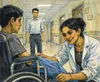
A woman in a white coat stood beside a teenage boy, maybe sixteen, who gripped a set of parallel bars. The boy's arms trembled with the effort of holding himself upright. Sweat beaded on his forehead and soaked through his t-shirt.
"Good," the woman said. Her voice was soft, patient. "Three more seconds. You can do it."
The boy's face contorted. His legs buckled and she caught him, easing him back into a wheelchair waiting behind him.
"Okay, that's enough for today. You held it eight seconds longer than yesterday."
"Felt like less," the boy muttered.
"Progress isn't always linear. The fact that you're trying is what matters." As she crouched beside the wheelchair, I got my first clear look at her face. Early forties, slender, dark circles under her eyes. Her lab coat looked like she'd been wearing it for too long, creased at the elbows and slightly wrinkled. A locket hung from a chain around her neck. Her overhead label read, "Dr. Priya Iyer, Neurology." The name I'd circled in three different victim files.
I watched as she adjusted the boy's blanket across his legs, checked something on his chart, spoke to him quietly. Nothing about her manner suggested someone connected to a string of deaths.
She noticed me standing in the corridor and held up one finger. Wait.
"Same time tomorrow?" she asked the boy.
"Do I have a choice?"
"You always have a choice. But I'll be here either way." She squeezed his shoulder, then waved over an orderly. "Take him back to his room. And make sure he gets the mango lassi, not the plain one."
The boy smiled at that.
She straightened and walked over to me, pulling off a pair of thin gloves. Her eyes flicked up to the label above my head. "Sorry about the wait, Inspector. What can I do for you?"
"Routine follow-up on the haemorrhage cases. Dr. Kapadia mentioned you've been treating some patients with similar symptoms."
With a gesture, she invited me to walk with her away from the physical therapy alcove. When we were out of earshot, she kept her voice low.
"Terrible situation. I've been going over my notes trying to understand what went wrong. Long-term neurological patients with mesh complications... sometimes the outcomes aren't what we hope for. But this many, this fast? I don't have answers for you, Inspector. I wish I did."
"Have you noticed anything that might link the victims? Any common factors?"
"I can't discuss specific patient histories without authorization. Privacy laws." She said it apologetically, not defensively. "But even if I could, I'm not knowing what I would tell you. Neurological conditions are complex. Every patient is different."
"Anything at all. Even general impressions."
She was quiet, her hand drifting to the locket at her neck.
"They were all fighting hard," she said finally. "That's what I remember. None of them were ready to give up." She paused. "I'm sorry I can't be more helpful. If you need official records, the hospital's legal department can process requests."
"Thank you for your time, Doctor."
She nodded and walked back toward the physical therapy alcove.
I turned toward the common area.
***
Over the next hour, I worked my way through the ward.
The common area had maybe fifteen patients. The ward nurse on duty agreed to help me approach patients well enough for questions.
Ten interviews. I kept the questions simple and consistent.
Where do you work? Where do you live? Do you have any relatives currently admitted to this hospital? When did your symptoms start? When was the last time you received a blessing with tilak?
I added new questions too, things that might explain what I'd been seeing. Any unusual skin conditions lately? Reactions to adhesives, cosmetics, anything applied to your face or forehead?
Everyone looked at me strangely at that last one. I asked anyway. Six years ago, I'd rushed a case, skipped one question, and a woman died for it. I didn't skip questions anymore.
My antenna glitched three times during the hour. Each dropout gave me ten to fifteen seconds. Enough to scan faces.
The pattern was undeniable.
In the first dropout, I counted six sheens among the patients in the common area. Foreheads catching the overhead lights with that same iridescent mark. A woman in her fifties with tremoring hands. A middle-aged man doing breathing exercises by the window. A young woman barely out of her twenties, walking loops around the room with a nurse steadying her elbow.
Second dropout: I looked at the nurses. Three of them moving through the common area, checking vitals, distributing medications. All three had the shimmer.
Third dropout: I was interviewing a Sikh man in his sixties, dignified even in his hospital gown, his turban carefully wound despite the circumstances. His forehead was clean. No shimmer at all.
I adjusted my questions for each patient, probing gently for connections.
Before her own symptoms started, the woman with tremoring hands had been visiting her mother in oncology for two months with breast cancer, stage four. She developed headaches first, then the tremors.
The man by the window worked security at a shopping complex in Andheri. No connection to Oberoi Pharmaceuticals, but he lived in Parel, just down the road from the factory. His wife was upstairs in the ICU, recovering from a stroke. He'd been visiting daily for six weeks.
When I asked about Dr. Iyer, his face changed. Something softened behind his eyes.
"She's wonderful," he said. "I know she's busy with other patients, but when she comes by to check on me..." He trailed off, embarrassed. "This will sound mad, Inspector. But I feel safe when she's here. Like when I was small and my mother would sit with me." He laughed awkwardly. "I'm old enough to be her father. I don't know why I feel that way."
Strange. I couldn't see how it connected to anything, but I wrote it down anyway. I moved on.
The young woman was a graduate student. Her mother had been admitted to neurology two months ago for seizures. She'd taken leave from her studies to help with care. Now she was here too, same symptoms. Different room.
Different story with the Sikh man. Parkinson's, early stage. He'd come in through his general practitioner for tremor management. No relatives in the hospital. No history of visiting other patients. His family brought him prasad from the Gurudwara. He'd never visited the courtyard shrine.
No shimmer.
I found a Muslim woman with a similar story. Admitted for something unrelated, no caregiving history, no extended time in hospital waiting rooms or shrines.
No shimmer.
I asked about Dr. Iyer. Most patients knew her. Mesh compatibility assessment, they said. Neural interface calibration. Some special test she'd developed. She'd been thorough, professional, caring.
When I asked about the shrine in the courtyard, the Bal Devi blessings, most patients said they'd received tilak at least once. Many had gone multiple times, seeking comfort during their vigils. The priests came twice a week, and visitors lined up for blessings the way they might line up for chai.
But the Sikh man hadn't received tilak. Neither had the Muslim woman. Neither had two other patients who'd come in through different departments for unrelated conditions.
And they didn't have the shimmer.
I closed my notebook. What was I actually seeing? And how did it connect to Dr. Iyer, to the deaths? But the pattern was clear now. Tilak recipients had the shimmer, non-recipients didn't. Solid evidence, but who would believe it?
Perhaps it was time to pay Jay a visit.