







Shimmers
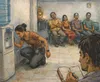
Sister Patil led us through a maze of corridors, past more waiting families and gurney-lined hallways, until we reached a set of double doors marked with colourful cartoon animals and bright overlays announcing visiting hours in three languages. We pushed through into the pediatric oncology family waiting room.
Plastic chairs lined three walls in faded blues and greens. A water cooler stood near the washroom door, a stack of disposable cups beside it. A notice board hung opposite, pinned with visiting hours and faded photos of recovered children.
In the corner nearest the security doors, families had built up a small multifaith worship space. A crucifix hung on the wall, age-darkened wood above a faded prayer card. Beside it, someone had taped a printed arrow pointing toward Mecca. But the central focus was a shrine with a statue of a god I didn't recognise, a child's face painted in bright colours. Fresh marigolds were arranged around it, their warm fragrance permeating the room. I wasn't religious myself, but I understood the impulse. When medicine can't promise anything, you look elsewhere.
About ten people occupied the waiting room, some watching AR screens, others still shaken from witnessing the collapse. Near the window, a woman was explaining confidently to the couple beside her, "I saw him eating non-veg from the canteen yesterday only. Oily-oily. Heart attack, what else do you expect?" Her husband sat beside her, hands knotted together, staring at us.
At the far end, security doors led into the ward proper. Their wire-reinforced windows revealed a nurse's station and a corridor beyond, patient room doors closed for privacy. Bright yellow signs warned that this was a clean space, PPE required, visitors limited to one at a time.
Sister Patil gestured toward the water cooler. "Here, saheb. He was standing, getting water, then just collapsed. We were at the station." She pointed through the security doors to where nurses sat at their consoles. "We heard shouts and came running."
Desai approached the water cooler and crouched beside it, examining the floor and the surrounding wall. She took mesh snapshots of her own view, documenting the scene. I let her work and turned my attention to the room itself.
The waiting families created a strange ecosystem. Each claimed a territory, chairs pulled together into small islands, bags and personal items marking boundaries. In a corner chair, a father slumped half-asleep or just exhausted. A mother sat upright and alert, watching something in her AR feed, her hands moving occasionally to interact with content only she could see. Near the washroom, two younger men watched us with careful neutrality.
My connection cut out and the ubiquitous environmental projections disappeared. Ambient music dropped to silence, leaving only plastic chairs creaking and distant voices from the ward beyond.
I stepped forward slowly, scanning faces. Something caught the overhead light.
A shimmer. Faint and iridescent, low on the forehead of the sleeping father. I shifted my angle and spotted it again on the watching mother. Then on one of the two younger men. Then the other. Four people, all with that same subtle sheen between their eyes, scattering light into barely visible rainbows.
My connection snapped back, teeth aching for a half-second, and the shimmers vanished as if they had never existed. The AR displays returned, cheerful and insistent.
I studied the four people. Ordinary faces, tired and worried, showing no trace of what I'd just seen. Five now, counting the dead man in the ICU.
Five people with the same mark. I didn't know what to make of it. I pulled out my notebook and flipped to a clean page, writing "strange forehead sheen" in my cramped shorthand. I underlined it twice.
"Mehta."
Desai stood, holding a small evidence bag with a disposable cup inside. "I'm taking a water sample. Could be contaminated."
"Smart."
She sealed the bag and labelled it virtually, then put it in her satchel. Sister Patil had donned fresh PPE and entered the security doors, speaking quietly with another nurse. They both glanced back at us through the window, expressions somber.
Behind us, a woman burst through the doorway, still in work clothes, a grey salwar kameez, a small purse clutched white-knuckled in both hands. She breathed hard, face flushed.
"Dinesh!" Her voice cracked. "Dinesh! Where is my husband? Kavya!" She looked around frantically, not registering the police presence, seeing only that her family wasn't where they should be.
A woman in a navy blue kurta and matching leggings emerged behind her, floating ID label marking her as social services. She stepped immediately to intercept, speaking in low tones, and guided her toward a door off the main waiting area. The sign above it read "Family Consultation" in English and Hindi.
Dr. Kapadia appeared moments later, white coat rumpled. He glanced at us, then at the consultation room, and went in without a word. The door closed behind him.
I exhaled slowly, grateful it wasn't my job this time, and glanced toward the ward. Somewhere behind those doors, a nine-year-old girl waited for her father to come back with a cup of water.
The wail cut through my thoughts, raw and primal, the sound of a person's world ending. Every face in that waiting room turned toward the consultation room door.
Desai and I exchanged a glance. The interview could wait.
"Chalo," I said quietly to Desai.
As we walked back through the corridors, neither of us spoke. Visitors and staff crowded the elevator, everyone politely not making eye contact. We rode down in silence and walked out through the main entrance into evening darkness.
Rain fell, a light but steady drizzle. We pulled on our rain jackets and walked toward the patrol car. The air had cooled, the pavement slick, reflecting streetlights.
I paused at the top of the steps leading down to the street and glanced back at the hospital. The building rose twelve stories, wedged between apartment towers and commercial blocks, every window glowing with light and activity. Below in the small courtyard, I could see a shrine similar to the one in the waiting room, this one larger and protected by a wooden shelter. Fresh flowers sat before the same child-faced statue, bright even at this hour. Someone was maintaining these shrines, keeping them supplied with offerings.
A figure in a thin black robe appeared beside the steps, hood pulled up. The fabric was woven with a tight copper grid pattern that caught the light. He was handing out real paper pamphlets to people leaving the hospital. Strange.
He offered one to Desai. She took it automatically, glanced at it, then crumpled it in her fist. "Anti-mesh cult types," she muttered.
The figure looked at me, nodded slightly, then moved on without offering me a pamphlet. I watched him walk away through the rain, approaching other people, most of whom ignored him or waved him off.
"Come on," Desai said. "We need to file reports on victim number seven."
Desai took the wheel, as always. Mumbai's evening traffic hemmed us in bumper to bumper, and motorcycles cut between lanes. I gazed out the window at the city passing by, towers rising into low clouds.
The mesh stuttered out yet again.
The traffic signals disappeared, the storefront signage replaced with bare concrete and glass. We passed under a streetlight and in that brief sweep of illumination I noticed something on Desai's forehead.
A rainbow glint. Right there, then gone again when my connection returned. The same mark I'd seen on five people at the hospital.
I looked at her. She drove on, eyes on the road, humming something under her breath. Normal. Completely normal.
Six.