


Have you been replaying our encounter in your mind, I wonder? You could have obtained my entire collection in that airport, all of it, in one bag. Only propriety stayed your hand. Alas, the opportunity will not come twice.
***
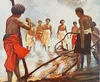
Beqa is a small island south of Viti Levu, in Fiji. Here the men of the Sawau walk barefoot across a pit of white-hot stones and are not burned. They call it the vilavilairevo, jumping into the earth oven, and the right to do it belongs to one priestly clan among them, the Naivilaqata. The method is simple, though no outsider can do it. The little gods of the forest, the veli, are called up and laid along the stones, and the walkers cross on their backs.
The heat is impressive. You might assume a trick to it. Tough soles, or a quick pace, maybe. But once you feel the heat come off the stones, still almost burning across ten feet of air, you know this to be impossible.
There used to be a careful preparation. The men kept apart from their wives for weeks. They touched no coconut, which the veli despise. A man whose wife was with child did not walk at all. Supposedly, if a man broke any of these, the fire would take him.
***
It is a show for tourists now, naturally. They do it on a cleared lawn for a ring of phone-wielding holidaymakers, and the preparation is mostly forgotten. The offerings, the seclusion, skipped. And still no one burns.
I turned from the edge of the ring because the pieces pulled the other way.
Their sibling was not in the pit. A cupboard in a back room held it, forgotten in the dark behind the ordinary clutter. I found it while the whole island watched the spectacle on the grass.
The pieces I carried and the piece in that house recognized each other at once, with me an eavesdropper. A despised one. I am not of the blood it gave its gift to. I am a woman, and the little gods tied to this one do not abide women.
But under the loathing, it begged me. It hated me and begged me in the same wordless thought. Humiliation. A small god, three hundred years honored, now shut behind the spare crockery by the very blood it had kept out of the fire. It wanted out. It wanted its own kind, which it felt on me. And beneath that, an uglier wish, coming off it hot as the stones. Take me, and let them burn for forgetting me.
I wanted it. It offered gifts, and I wanted them too. For me and all my descendants. I had only to close my hand.
Me. Descendants. As if.
***
I did not take it.
Why? Choose the explanation that fits your preconception of me best. Sentimental? Perhaps I did not wish to read about horrific burn injuries in front of tourists. Obstinate? Perhaps I just dislike being told what to do by things that hate me. Temperate? Perhaps I wanted to prove to myself I could say no.
Yeah, I’m skeptical of that one too.
If you want to take it, it’s still there. You can own the consequences. But if you merely want it hidden and forgotten, no need. It already is.
— N.

In the principal telling of the vilavilairevo’s origin, the ancestor Tuiqalita, hunting an eel in a pool of the upper Namoliwai river, instead caught Tui Namoliwai, chief of the veli, and, sparing him, refused his offers of war, wealth, voyaging, and love. He accepted only power over fire for himself and his descendants. A vice-regal audience watched the rite at Nawaisomo on 1 September 1892, recorded by Basil Thomson and photographed by J. W. Lindt; the physician Robert Fulton offered “a probable explanation of the mystery” in 1902, by which time it was already a tourist attraction. The stones are kept near a thousand degrees. The Sawau, through the Sawau Project, have since asserted communal ownership of the ceremony against its commodification.