







A Ship, Three Hundred Kilometres Inland
Walga Rock, and a Nhanda boy with blue eyes
Correct! Captain Pelsaert put the first white Australians, Loos and de Bye, ashore with a flat-bottomed boat and likely the piece at the mouth of the Hutt River, Port Gregory, four hundred years ago. Naturally you went there. Your team is better than mine. Your equipment is better than mine. If there was anything in that estuary, you would have found it.
But two lost strangers would not have stayed there long. They would have followed the coastline until they found other people. That is where I went.
***
Kalbarri. The Murchison River meets the sea here, two thousand kilometres of river country ending at red sandstone cliffs. The Nhanda have lived along this coast longer than the Dutch have existed.
The Nhanda speak of the Dreaming, the ancestral layer that runs beneath the land, still present, accessible through place and practice. A serpent called Beemarra carved the gorge. If she remained in this Dreaming, if she witnessed, I intended to ask. The pieces have allowed stranger things. I slept on a rock by the river.
Nothing happened. The stars were extraordinary.
***
At dawn a Nhanda teenager found me on the rock. He was out with his grandmother for the week, taking photographs for her on her phone.
He had blue eyes.
I told him what I was looking for. Something that had come through here in the 1600s. He didn’t know what I meant, but he knew about the old trading. Everything that moved through this country moved up the river. East. The big gathering place was Walga Rock, near Cue. The old people had come from across the continent to trade there.
I went too.
***
Walga Rock. A granite monolith forty-eight kilometres west of Cue, in the upper Murchison country. The largest gallery of Aboriginal rock art in Western Australia fills a cave on its southern face: emus, snakes, kangaroos, handprints, ten thousand years of record.
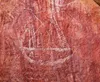
And one sailing ship.
White ochre. Two masts, portholes, rigging. Three hundred kilometres from the nearest coast. The researchers who have studied it cannot agree on what it is. One theory: a Dutch sailor, taken in by the Nhanda after a wreck, painted it from memory.
The theory was wrong. Torrentius’s artifact had shown them. It was no longer here, but east.
Do use your resources to narrow it down.
— N.

Photo: CJ Ison / Talesfromthequarterdeck
Rupert Gerritsen argued in “And Their Ghosts May Be Heard” (1994) that sixteen percent of the Nhanda language derived from Dutch, absorbed from two men marooned on the coast in 1629, though academics reject the theory.
Later European explorers documented blue-eyed Aborigines in the region.