


Count the Lights
Boulia, where the Min Min follow you
Your people chartered out of Townsville and were on the ground before I had crossed the border. Credit where due: you read the trail correctly. East, from Walga Rock, along the trade roads.
Then you followed the wrong roads. The telegraph line, the stock routes, the rail. European lines, on European maps. The roads that carried the piece are older.
You stood one day’s drive from the answer, found nothing, and flew home.
***
Boulia. Channel Country lies flat to every horizon, gibber plain and blacksoil. The town of three hundred sits on the Burke River. In the wet, the rivers here braid into a thousand channels and the land becomes water. In the dry, which is most of the time, it becomes a distance that makes people quiet.
The pituri fields are on the Mulligan, west of town. For thousands of years the narcotic leaf was picked there, cured in sand pits, packed into woven bags, and traded across half the continent. Shell from the gulf, ochre from the west, stone axes from the quarries at Mount Isa, all of it moved through here, paid for in pituri. The roads ran east. So did the piece.
I slept on the plain, away from the road. You will recall the last time I did this, on a rock by the Murchison, and nothing came.
This time the light came.
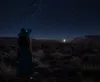
It rose off the horizon and held there, white, at the height of a standing person. When I walked toward it, it receded. When I stopped, it stopped. When I moved, it moved.
The pieces in my bag grew warm.
The light cut out.
The locals have theories: gas, headlights, refraction, the dead. The sightings cluster in this country and nowhere else, and the oldest accounts date to the decades after 1884.
***
Battle Mountain is in Kalkadoon country, north, past Mount Isa, near the ruins of Kajabbi. In September 1884 the Kalkadoon, who had fought the incoming pastoralists and native police for years and fought them well, made a stand on its slopes. They charged downhill into rifle fire. The numbers in the records are disputed, though the outcome isn’t. That day ended the Kalkadoon wars, and nearly the Kalkadoon.
The piece had been on that mountain. It had come up the pituri roads a long time before and it was a kept thing, a strong thing, and when the wars came it went where the people went.
It did not survive the day intact. Someone chose to break it there, on that mountain, knowing what the troopers would take and what must not be taken whole.
The fragments went in every direction. Some buried. Some carried. Some picked up over the following decades by stockmen and fencers and souvenired into oblivion, lost along the stock routes, dropped in the blacksoil.
Your people did not invent scattering as containment. A Kalkadoon survivor worked it out under fire, in an afternoon.
***
One fragment stayed in careful hands, and one was enough. I sat with the keeper for an evening. I will not tell you who, or where, and before your analysts reach for the obvious: the pieces I carry were in the same room as the shard for several hours. They had a great deal to say to each other.
I left the shard where it was. Feel free to acquire it now. I have what I need.
As for the rest, every fragment loose in this country thins its own small patch of night, and the country reports them, one by one, to anyone standing on the plain after dark.
You wanted an inventory of the missing. Count the lights.
— N.

The Min Min light is an unexplained luminous phenomenon reported in the Channel Country of western Queensland, most often near the town of Boulia. Witnesses describe a glowing light, usually white, that hovers above the horizon and appears to follow or recede from observers. Accounts have been recorded since the late nineteenth century. Proposed explanations include refracted light from distant sources, bioluminescence, and atmospheric ducting, though no single cause is universally accepted.