



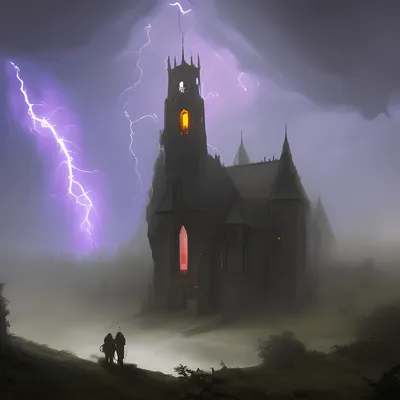

Malygris the magician sat in the topmost room of his tower that was builded on a conicall hill above the heart of Susran, capital of Poseidonis. Wrought of a dark stone mined from deep in the earth, perdurable and hard as the fabled adamant, this tower loomed above all others, and flung its shadow far on the roofs and domes of the city, even as the sinister power of Malygris had thrown its darkness on the minds of men.
Now Malygris was old, and all the baleful might of his enchantments, all the dreadful or curious demons under his control, all the fear that he had wrought in the hearts of kings and prelates, were no longer enough to assuage the black ennui of his days. In his chair that was fashioned from the ivory of mastodons, inset with terrible cryptic runes of red tourmalines and azure crystals, he stared moodily through the one lozenge-shaped window of fulvous glass. His white eyebrows were contracted to a single line on the umber parchment of his face, and beneath them his eyes were cold and green as the ice of ancient floes; his beard, half white, half of a black with glaucous gleams, fell nearly to his knees and hid many of the writhing serpentine characters inscribed in woven silver athwart the bosom of his violet robe. About him were scattered all the appurtenances of his art; the skulls of men and monsters; phials filled with black or amber liquids, whose sacrilegious use was known to none but himself; little drums of vulture-skin, and crotali made from the bones and teeth of the cockodrill, used as an accompaniment to certain incantations. The mosaic floor was partly covered with the skins of enormous black and silver apes: and above the door there hung the head of a unicorn in which dwelt the familiar demon of Malygris, in the form of a coral viper with pale green belly and ashen mottlings. Books were piled everywhere: ancient volumes bound in serpent-skin, with verdigris-eaten clasps, that held the frightful lore of Atlantis, the pentacles that have power upon the demons of the earth and the moon, the spells that transmute or disintegrate the elements; and runes from a lost language of Hyperborea. which, when uttered aloud. were more deadly than poison or more potent than any philtre.

But, though these things and the power they held or symbolized were the terror of the peoples and the envy, of all rival magicians, the thoughts of Malygris were dark with immitigable melancholy, and weariness filled his heart as ashes fill the hearth where a great fire has died. Immovable he sat, implacable he mused, while the sun of afternoon, declining on the city and on the sea that was beyond the city, smote with autumnal rays through the window of greenishyellow glass, and touched his shrunken hands with its phantom gold and fired the bales-rubies of his rings till they burned like demonian eyes. But in his musings there was neither light nor fire; and turning from the grayness of the present, from the darkness that seemed to close in so imminently upon the future, he groped among the shadows of memory, even as a blind man who has lost the sun and seeks it everywhere in vain. And all the vistas of time that had been so full of gold and splendor, the days of triumph that were colored like a soaring flame, the crimson and purple of the rich imperial years of his prime, all these were chill and dim and strangely faded now, and the remembrance thereof was no more than the stirring of dead embers. Then Malygris groped backward to the years of his youth, to the misty, remote, incredible years, where, like an alien star, one memory still burned with unfailing luster—the memory of the girl Nylissa whom he had loved in days ere the lust of unpermitted knowledge and necromantic dominion had ever entered his soul. He had well-nigh forgotten her for decades, in the myriad preoccupations of a life so bizarrely diversified, so replete with occult happenings and powers, with supernatural victories and perils; but now, at the mere thought of this slender and innocent child, who had loved him so dearly when he too was young and slim and guileless, and who had died of a sudden mysterious fever on the very eve of their marriage-day, the mummylike umber of his cheeks took on a phantom flush, and deep down in the icy orbs was a sparkle like the gleam of mortuary tapers. In his dreams arose the irretrievable suns of youth, and he saw the myrtle-shaded valley of Meros, and the stream Zemander, by whose ever-verdant marge he had walked at eventide with Nylissa, seeing the birth of summer stars in the heavens, the stream, and the eyes of his beloved.