







D15: One Night to Rob a Shrine
When every god in Japan travels to Izumo, and no one is home
I’ve arrived in mainland Japan, and found it a challenge orienting myself to this place. Alipore senses so many of its kin that it’s hard to determine where to start. Centuries without your people cataloging and hiding and neutralizing have left this land ripe for the picking.
In the months since I last wrote, I’ve spent my nights cramming kanji flashcards and my days holed up in archives, cross-referencing dormant shrine registries and folklore surveys with my phone and Google Translate. I have a substantial list now.
A few I’ve crossed off. Dormant shrines with only ceremonial items, nothing stronger.
***
Izumo sits on the Shimane coast, on the Sea of Japan, and its shrine, Izumo Taisha, is among the oldest in the country. The god there is Ōkuninushi, lord of the hidden world of the dead and spirits. He also keeps the record of who is bound to whom, so people travel from all over to petition him about their marriages.
Once a year he has company. In the tenth month of the old calendar every god in Japan leaves its own shrine and travels to Izumo to confer. The rest of the country, emptied, calls it the month without gods. Here it is the month the gods are present.
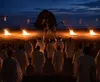
They are met on the beach. After dark the priests go down to the water at Inasa-no-hama, light fires on the sand, and wait, facing the sea. A massive boulder stands at the waterline with a torii gate and a small shrine on its top, and the gods come in from the sea beyond it. A sea snake carried in on the autumn current is lifted from the surf and taken as their herald. The gods are received into branches of sakaki, an evergreen tree, and walked inland to the shrine behind a screen of white cloth held up on either side, for their privacy. After a week they are dismissed.
***
The shrine I wanted was not that large one, but a smaller one nearby. It had its own god and its own lineage of caretakers, one that ran out of heirs by birth or marriage. Two winters ago, the last one passed. Even the village was half empty. Still a religious corporation on paper, in practice it was a locked building no one had the standing to open.
I went the night of the welcoming of the gods. While the priests stood at the water with their fires, and this shrine’s god was among the crowd coming ashore at Izumo, no one noticed a woman pop the lock and step inside.
It was one room. Dust lay over the floor, and on the altar a dish of rice had dried to a crust. Behind a curtain I found it, boxed and wrapped.
Alipore said nothing, and I thought it was another dead end from my list, that I had crossed the country for an heirloom. I unwrapped it. The cloth was stiff with age. I felt nothing from the thing inside, like the nothing an ordinary heirloom gives. But this nothing was something, and I recognized it. A piece. I wrapped it again and carried it out.
***
How are you faring without your usual tools? A phone call and a name won’t open the same doors here. You’ll have to submit polite requests rather than orders and threats.
I can lend you my flashcards if you like.
— N.

Ōkuninushi is the god of Izumo, in myth the ruler of the unseen world (kakuriyo), the realm of the dead and of spirits. When Japan built State Shinto in the nineteenth century, a dispute over the national pantheon set Izumo against Ise: the Izumo priesthood held that Ōkuninushi, as lord of the afterlife, belonged among the supreme deities. In 1881 the question was settled by imperial authority in favor of Ise and the sun goddess Amaterasu. Ōkuninushi was excluded, and the teachings built around him were reclassified as “Sect Shinto” — private religion, publicly unfunded, set apart from the non-religious state ritual of the shrines.