






Evaporate Yourself
Osaka, where a god was sold
Have you ever wanted to disappear? In Japan, there’s a service for that.
The word is jōhatsu, evaporation. You call a night-moving company, they arrive after dark, pack your rooms, cancel your phone, and set you down in another city with no forwarding address.
I haven’t seen you around lately. Did you jōhatsu?
***
Osaka greets me with an “Irasshai!” and a “Maido!” as I push my way through markets crammed with knife stalls and fugu tanks. It is a city that loves a deal, and one old greeting here translates as “making any money?”
The next name on my list was a shrine in an outer ward, wedged between an apartment block and a pay lot, a vending machine glowing at the gate. The family that had kept it ran a narrow trade: severance. Petitioners came to spiritually cut ties they could not cut themselves.
A shrine here is a religious corporation. Sell the corporation and everything inside transfers with it: ceremonial items, god, piece and all.
The keeper herself was four months gone. Not dead, I checked. The building stood open, one room, swept bare. In the middle of the floor I could not hear the street. A step to either side and the street came back. I tested it three times.
***
Kamagasaki is where many of the jōhatsu go. In 1966 Osaka struck the name from its own maps and renamed the district Airin, love thy neighbor. The residents never adopted the correction. Twenty thousand men, give or take, in lodging houses with rooms of three tatami mats. “Give or take,” because the census has stopped trying to count them. You would hate it here.
A man nobody is bound to can get a bed there, and no questions.
The police were polite, but no crime means nothing to investigate. The ward office was polite, but resident records are private, even from family, and I was not family. The detective I hired listened to the whole story, named his fee, and then, in case I had misunderstood my own errand, named the price of disappearing me instead. Amusing, all things considered.
It took nine days to find her, and not because nobody knew her. The detective asked the questions, I paid for the tea, and Alipore kept him working past what I was paying him. Men stand in the doorways there all day, watching the street. On the second day I counted nineteen down one row and my hireling counted seventeen. We walked it again and got seventeen. On the ninth day a lodging-house manager took my money upstairs and knocked on a door for me.
She answered the door alive and unremarkable. Nothing in the room had come from the house. Against the wall stood four months of women’s manga magazines.
She talked. They rarely refuse me now, but she had little to tell. Four hundred years of custody ended with her. No child, no apprentice, and the rules of her house forbade a stranger. Then a man arrived with a lawyer and an offer. She signed everything away in one afternoon and paid a night mover out of the proceeds. The money, most of it, was in an envelope on her shelf. She could not stay where people knew what her family had been, so she came to the district where no one is bound to anyone.
I asked where it all went. She poured the tea and said the man had not told her, and she had made a point of not asking.
Nobody had taken her. She quit.
***
The buyer had months on me. It reads as your method, the same as the auction: the whole lot bought sight unseen, over the phone, by a client who never came.
If so, good game.
— N.

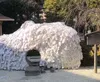
KOKOKU-m1ne10, CC BY-SA 4.0, via Wikimedia Commons
Enkiri, "bond-cutting," is a standing service at Japanese shrines and the counterpart to enmusubi, bond-tying. At Yasui Konpira-gū in Kyoto the petitioner writes a wish on a katashiro, a paper cut in the shape of a person, then crawls through a hole in a stone: front to back to sever the tie, back to front to form a better one. The stone itself cannot be seen under the charms pasted over it. Petitions are made against marriages, debts, drink, illness, and employers. The shrine's god is Emperor Sutoku, exiled to Sanuki after his defeat in 1156. The capital refused the sutras he copied in exile and sent back. He bit his tongue, wrote an oath in his own blood vowing to become the great demon king of Japan, and is counted among the country's three great vengeful spirits.