








Remote Alaska
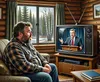
Jim Everett sat in his one-room cabin forty miles north of Fairbanks, whittling a piece of birch wood while the Alaskan wind howled through the spruce trees outside. He had built this place with his own hands fifteen years ago, after deciding that civilization had gone completely insane. No internet, no cell phone, no neighbors within twenty miles—just him, his books, and the peace that came from living off the grid.
The ancient television set in the corner hadn't been turned on in three months. Jim kept it mainly for severe weather warnings, though the fuzzy reception from Juneau barely qualified as watchable most of the time. So when the TV suddenly flickered to life on its own, displaying a clear, high-definition image of a man in a gray suit standing at a podium, Jim nearly dropped his knife.
"What the hell?" he muttered, reaching for the remote control. The image showed a massive stadium filled with people, focused on a single figure speaking with the cadences of biblical language. Jim had grown up in a nominally Christian household but hadn't set foot in a church since his mother's funeral twenty years ago.
He clicked the remote to change channels. The same preacher appeared on channel 4. He clicked again—same man on channel 7. Every channel displayed the identical image of the preacher delivering his sermon about fallen worlds and divine judgment.
"The world is fallen," the man declared, "and we are ruled by servants of Satan."
Jim stared at the television, his practical mind struggling to explain how every channel could be broadcasting the same program. More disturbing still, how was his television receiving such a clear signal when it could barely pull in local stations on the best days?
Despite his religious skepticism, something about the preacher's voice compelled attention. Jim found himself listening as the man described his own death and resurrection, his trial before divine judgment, and his commission as God's prophet. The words carried an authority that bypassed intellectual resistance and spoke directly to something deeper.
Jim set down his whittling and leaned forward in his chair, drawn into a message he would have dismissed as religious nonsense just minutes before.
Small Town Michigan
Susie Andrews lay sprawled across her bed in her small-town Michigan bedroom, thumbs flying across her phone screen as she maintained simultaneous text conversations with seven different friends. At sixteen, she had perfected the art of digital multitasking, switching between Instagram, Snapchat, and text messaging with the fluidity of a conductor directing an orchestra.
She was in the middle of typing "OMG did you see what Jake posted???" when her phone screen suddenly filled with a video of a man in a suit speaking from what looked like a massive stadium stage. The video had appeared without her selecting anything, interrupting her text mid-sentence.
"What the heck?" Susie tapped the X button to close the video, but it immediately restarted. She tried swiping it away, pressing the home button, even turning the phone off and on—nothing worked. The video continued playing, showing the preacher speaking in language that sounded like something from an old movie.
"This is so weird," she muttered, then noticed her phone was still connected to WiFi and showing full battery. She opened her messages app to complain to her friends about the glitch, but the video minimized and continued playing in a small window while she typed.
The preacher was talking about Adam and Eve, but in a way she'd never heard before—not the gentle Sunday school version, but something darker and more serious. Despite her annoyance at the technical malfunction, Susie found herself pausing her typing to listen.
"She saw that the tree was good for food, and that it was pleasant to the eyes, and a tree to be desired to make one wise..."
The old-fashioned words somehow held her attention in a way that her pastor's contemporary sermons never had. Susie realized she had stopped trying to close the video and was actually watching it.
New York Suburbs
Rabbi Moshe Kahn was finishing his dinner of leftover brisket and potatoes when he heard the unmistakable sound of a television broadcast coming from his living room. This was puzzling for several reasons, the most obvious being that his wide-screen TV had been dead for months and wasn't even plugged into the wall.
Setting down his fork, Moshe walked into the living room and stopped dead in his tracks. The 55-inch screen displayed a crystal-clear image of a Christian preacher delivering a sermon to what appeared to be tens of thousands of people. The man was speaking about Moses and the Israelites in the wilderness.
"Because of their rebellion and unbelief, God made them wander in the wilderness for forty years..."
Moshe's eyes immediately went to the power cord, which lay coiled on the floor beside the entertainment center. The TV definitely wasn't plugged in. He looked around for the remote control and found it on the coffee table, then pointed it at the screen and pressed various buttons. Nothing happened. The preacher continued his discourse about the generation that perished in the desert.
As a Reform rabbi, Moshe had spent his career studying the Torah and its interpretation. The preacher's account was biblically accurate but delivered with a passion and authority that was uncommon in contemporary Christian preaching. The man spoke of Moses and the giving of the law with intimate knowledge, as if he had been present at Sinai himself.
Moshe found himself drawn into the theological content despite the impossible circumstances of its delivery. He picked up the power cord, confirming it was indeed unplugged, then returned his attention to the screen where the preacher was describing the golden calf incident with vivid detail.
YouTube Headquarters
Nitish Patel stared at his monitoring screens in the YouTube traffic control center, watching numbers that made no sense whatsoever. At exactly 8:00 PM Eastern time, almost all outbound traffic from YouTube's servers had shifted to a single stream: "John Foster Ministries, Day 1." The bandwidth usage graph showed an impossible spike—millions of simultaneous viewers watching the same Dallas-based religious broadcast.
"This can't be right," Nitish muttered, pulling up the stream details. The video showed a preacher in a stadium, speaking about biblical history and divine judgment. The viewer count was climbing exponentially—already over fifty million concurrent viewers and still rising.
His phone rang with the distinctive tone reserved for emergency calls from management.
"Patel here."
"Nitish, what the hell is going on with our traffic monitoring?" His boss sounded frantic. "Every dashboard is showing the same anomalous pattern."
"No shit," Nitish replied, forgetting professional courtesy. "It's some stream out of Dallas sucking up all the bandwidth. Every user on the platform seems to be watching the same religious broadcast."
"Shut it down. Now."
Nitish pulled up the administrative controls and clicked the "Terminate Stream" button. Nothing happened. He tried again, then attempted to access the account settings for John Foster Ministries. Every command he entered was ignored by the system.
"Sir, I can't terminate the stream. The system isn't responding to administrative overrides."
"What do you mean it's not responding?"
Nitish tried every emergency protocol in the book—nothing worked. The stream continued broadcasting, consuming bandwidth and reaching an audience that now exceeded one hundred million viewers worldwide.
On his screen, the preacher was explaining how each generation of Israelites had become more wicked than the last, his voice carrying an authority that seemed to transcend the digital medium through which it was being transmitted.
Pentagon
General Stan Miller was deep into a classified video conference about weapons shipments to Ukraine when his secure terminal suddenly went dark. Instead of the expected NATO briefing slides, his screen now displayed a Christian preacher addressing a massive crowd in what appeared to be a football stadium.
"What in the Sam Hill—" Miller immediately tried the standard reboot procedure, pressing Ctrl-Alt-Del repeatedly. The computer ignored every command, continuing to stream the religious broadcast at full volume.
The preacher was discussing the era of the Judges, speaking about cycles of rebellion and divine judgment with the kind of historical knowledge that Miller, as a student of military history, recognized as authentic scholarship.
Miller's secure phone rang—three other generals calling about identical problems with their classified systems. Across the Pentagon, secure terminals that should have been immune to outside interference were all displaying the same Dallas preacher.
"Sir, this is a security breach of unprecedented magnitude," his aide reported breathlessly. "The stream has penetrated every classified network in the building."
Miller watched the preacher describe how "every man did what was right in his own eyes" during Israel's chaotic period, and found himself wondering if the same could be said about their current moment in history.
White House
Sarah Montgomery, the President's Chief of Staff, sat in her West Wing office staring at six wall-mounted screens that normally displayed different news networks. Every screen now showed the same image: a preacher in a gray suit delivering what appeared to be a prophetic sermon to tens of thousands of people.
She vaguely remembered the name John Foster from intelligence briefings about some incident in Dallas months earlier—something about a businessman who claimed to have returned from the dead. The briefings had been classified and quickly buried, but now the name was appearing on every screen in the White House.
Her desk phone erupted with simultaneous calls—all six lines ringing at once, including the red phone that connected directly to the Oval Office. She grabbed the red phone first.
"Sarah, what the hell is going on?" The President's voice carried barely controlled panic. "I can't watch Fox News because some preacher has taken over every damn channel. Are we under attack?"
Before she could answer, her secure computer terminal also switched to the same broadcast. The preacher was now describing the current generation as more wicked than any in history, his words carrying implications that made Sarah's blood run cold.
"Mr. President," she said carefully, "I think we need an emergency briefing. This John Foster situation appears to be far more significant than anyone previously understood."
On every screen around her, the preacher continued his sermon, his voice penetrating the highest levels of government with a message that earthly powers seemed helpless to stop.