





































































John Foster pulled into the parking lot of St. Nicholas Orthodox Church just before ten o'clock, the morning sun casting brilliant light across the building's distinctive golden dome. The church stood alone on a small hill, its traditional Byzantine architecture a striking contrast to the modern strip malls and office buildings that surrounded it. The structure faced east, as was proper for Orthodox churches, and the great dome gleamed like a beacon in the Texas morning light.
He had called Father Mark Appleton at seven AM, apologizing for the early hour but explaining that he needed to see him urgently. To John's surprise, the priest hadn't seemed shocked by the request or the timing. "I've been expecting your call, Mr. Foster," Appleton had said in a voice that carried both wisdom and gentleness. "Can you be here at ten o'clock?"
Now, as John approached the entrance beneath the dome's shadow, he wondered what the angel Raphael had meant about the priest being "prepared" for this moment. The heavy wooden doors opened easily under his touch, and he stepped into the narthex, immediately struck by the profound silence that seemed to embrace him.
But it was when he entered the nave itself that John's breath was taken away completely.
The interior of the church was a symphony of sacred art unlike anything he had ever experienced. Icons covered every surface—the walls, the pillars, the iconostasis that separated the nave from the altar area. But it was the dome overhead that made him stop in his tracks. There, gazing down at him with eyes that seemed to penetrate straight into his soul, was an enormous icon of Jesus Christ Pantocrator. The image was so lifelike, so filled with divine presence, that John felt as though he were standing before the living Christ himself.
The eyes in the icon seemed to follow him as he moved deeper into the church, and John found himself unable to look away. This was not the gentle Jesus he had walked with in paradise, but the Christ of majesty and judgment, the King of Kings whose very gaze could see through all pretense and into the depths of a man's heart.
"It's beautiful, isn't it?"
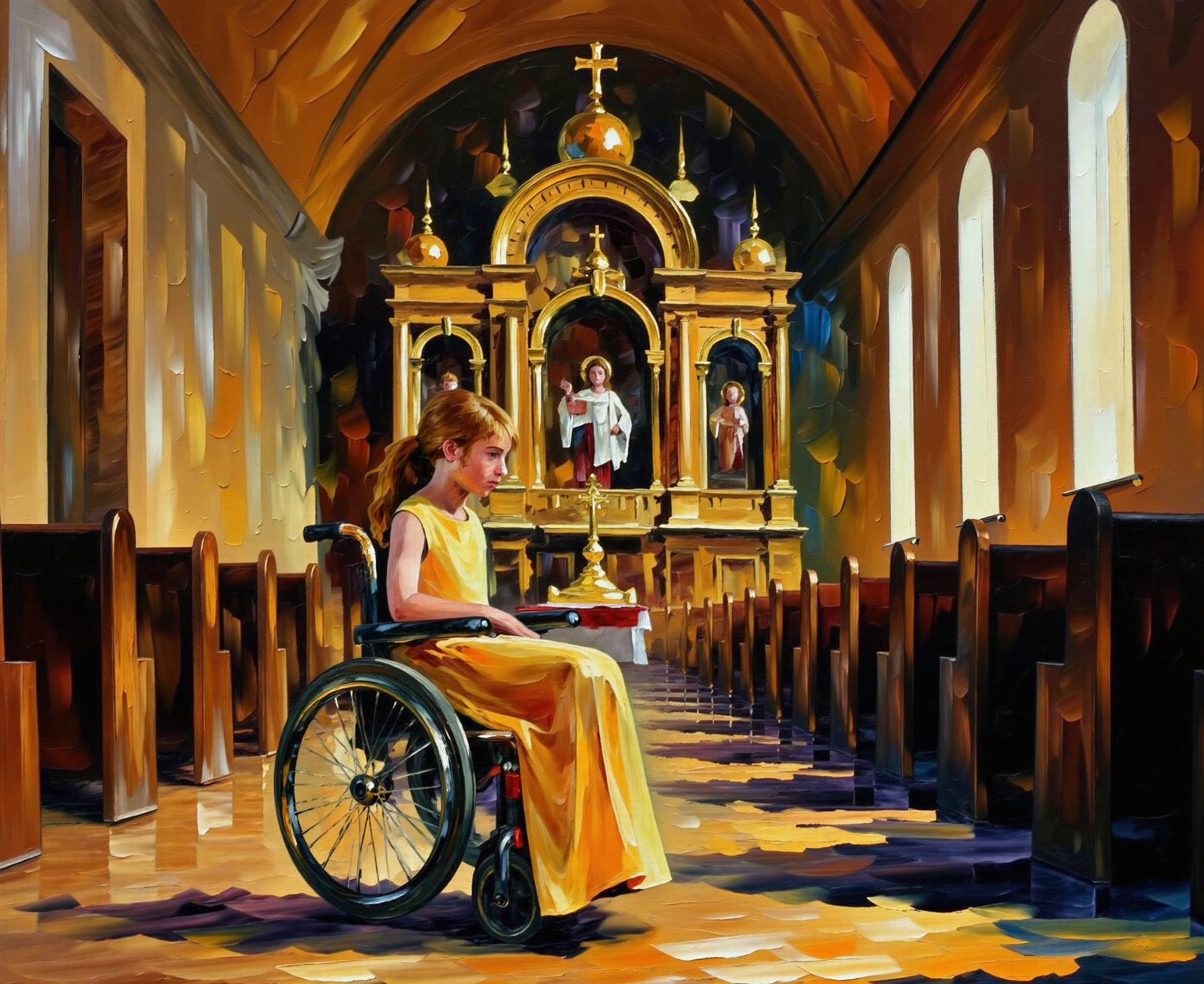
The gentle voice startled John from his reverie. He turned toward the sound and saw a young girl, perhaps ten or eleven years old, sitting in a wheelchair near one of the side chapels. She had dark hair pulled back in a simple ponytail and large brown eyes that sparkled with intelligence and something else—a depth of faith that seemed remarkable in one so young.
John approached her carefully, his heart already beginning to understand why he had encountered her here, in this sacred space, at this momentous time.
"Yes, it is beautiful," he agreed, kneeling down so he could speak to her at eye level. "What's your name, sweetheart?"
"Sophia," she replied with a smile that lit up her entire face. "My parents are talking to Father Mark about something. They told me to wait here and pray."
John studied her face, seeing both innocence and a kind of patient suffering that broke his heart. "Sophia, may I ask why you're in the wheelchair?"
Her expression grew more serious, but she didn't seem upset by the question. "I was doing gymnastics two years ago. There was an accident on the uneven bars, and I hurt my spine. The doctors say I'll never walk again." She paused, then added with remarkable composure, "But my grandmother says that's up to God, not the doctors."
John felt the familiar stirring within him—the power that Jesus had granted him, the gift that the angel Raphael had confirmed just hours earlier. But more than that, he felt an overwhelming compassion for this child who bore her suffering with such grace.
"Sophia," he said softly, "would it be all right if I offered a prayer for your recovery?"
Her eyes widened slightly, and she nodded with an eagerness that made John's chest tighten with emotion.
John placed his hands gently on her shoulders and closed his eyes, feeling the power of the Holy Spirit moving through him like a river of divine energy. When he spoke, the words came from somewhere deeper than his conscious mind.
"Lord Jesus Christ, Son of God, have mercy on me, a sinner," he began, recognizing the ancient Jesus Prayer that somehow now flowed naturally from his lips. "Bless this child and heal her. I pray in the name of the Father, and of the Son, and of the Holy Spirit. Amen."
"Amen," Sophia whispered, and she reached out to take John's hand.
The moment their skin touched, the air above them began to shimmer with golden light. John looked up and gasped as a luminous cross materialized in the space directly over their heads—not made of wood or metal, but composed entirely of brilliant, burning light that seemed to pulse with the very heartbeat of creation.
Sophia's grip on his hand tightened, and she let out a small gasp of wonder. Then, as John watched in amazement, she slowly began to rise from her wheelchair. Her legs, which had been motionless for two years, responded to her will as she stood upright, her face radiant with joy and disbelief.
A loud shriek pierced the silence of the church—a sound of pure shock and overwhelming emotion. John turned to see a man and woman standing before the iconostasis with Father Mark Appleton, all three of them staring in stunned amazement at what they were witnessing.
"Sophia!" the woman cried out—clearly the girl's mother—and both parents rushed toward their daughter, who was now standing steady and strong beside her abandoned wheelchair.
What followed was a scene of joyous pandemonium that filled the sacred space with celebration. The mother swept Sophia into her arms, weeping tears of joy while the father stood behind them, his face a mixture of wonder and gratitude. Father Appleton approached them, his own eyes glistening with tears as he began to recite a prayer of thanksgiving in both English and what John understood as Greek.
John stepped back, overwhelmed by what he had just witnessed and participated in. The burning cross above them began to fade, its golden light slowly dissolving back into the normal illumination of the church, but the miracle of healing remained. Sophia was whole, restored, walking and laughing in her parents' embrace.
After several minutes of celebration and tearful gratitude, the family prepared to leave. Sophia herself insisted on pushing her former wheelchair, declaring that she wanted to donate it to someone else who might need it. As they reached the door of the nave, she broke away from her parents and ran back to John.
"Thank you," she said simply, throwing her arms around him in a fierce hug. "I knew God would send someone to help me."
After the family departed, their voices still echoing with joy as they made their way to the parking lot, the church fell into a profound silence. Father Appleton and John stood alone in the nave, both of them processing what they had just witnessed.
Then, without warning, the area behind the iconostasis began to fill with light—but not the golden radiance of the healing cross. This was something far more magnificent and terrible: the glory cloud of the Almighty himself, the same divine presence that had filled the temple of Solomon and led the Israelites through the wilderness.
Father Appleton immediately prostrated himself on the floor, his face pressed to the ancient stones. John felt his own knees buckle as the overwhelming presence of God filled the sacred space.
When the Voice spoke, it came from everywhere and nowhere, resonating through every fiber of their beings with the authority of the Creator of all things:
"MARK APPLETON, FAITHFUL SERVANT, ANOINT THIS MAN JOHN FOSTER AS MY PROPHET. THROUGH HIM SHALL MY WORDS BE PROCLAIMED TO A GENERATION THAT HAS FORGOTTEN MY NAME."
Father Appleton rose slowly, his face pale but filled with holy determination. The wings of a cherubim extended out of the glory cloud holding a small vessel. Without hesitation, he moved to the altar and retrieved the vessel which contained chrism—the holy oil used in Orthodox sacraments. His hands trembled slightly, but his voice was steady as he began to speak words that seemed to come from the depths of ancient tradition, though John sensed this was a ritual that had never been performed before.
"In the name of the Father, and of the Son, and of the Holy Spirit," Father Appleton intoned as he anointed John's forehead with the sign of the cross, "I anoint you, John Foster, as a Prophet of the Most High God. May His words be upon your lips, His wisdom in your heart, and His protection around you all the days of your calling."
As the holy oil touched his skin, John felt a final transformation take place within him. The gifts that Jesus had granted him were now sealed by divine authority, confirmed by angelic visitation, and consecrated through sacred ritual. He was no longer simply a man who had died and returned—he was a Prophet of God, called to speak truth to a world that desperately needed to remember its Creator.
The glory cloud slowly faded, leaving them once again in the gentle morning light filtering through the church's windows. But everything had changed. John Foster had entered St. Nicholas Orthodox Church as a man wrestling with an impossible calling. He left as an anointed Prophet of the Almighty, ready to begin whatever mission God would set before him.