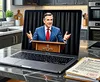










Pastor David Richardson sat alone in his modest kitchen in Plano, Texas, the termination letter from Riverside Community Church still lying on the coffee table beside his laptop. After eighteen years of faithful ministry, he had been dismissed a week earlier for refusing to perform a same-sex wedding ceremony, a decision that had split the congregation and ultimately cost him his pulpit.
The church board's vote had been close—seven to five against him—but the writing had been on the wall for months. The new members who had joined over the past two years were more interested in social activism than biblical exposition, and they had gradually gained influence through their financial contributions and political connections.
Now, at fifty-two years old, David found himself without a church, without income, and facing the possibility that his twenty-five-year ministry career was over. No evangelical denomination would hire a pastor who had been terminated for "bigotry and lack of compassion"—the official reason given by the board despite his spotless record of service and his genuine love for all people, including those struggling with sexual sin.
His wife Karen had gone to bed hours earlier, exhausted by the stress of job hunting and preparing to sell their home. Their two teenage children were staying with Karen's sister while the family figured out their next steps. The isolation was crushing, but David had learned that standing for capital-T truth often meant standing alone.
When his laptop screen suddenly came alive with the John Foster Ministries broadcast from Robber Baron Stadium, David's first impulse was to close it and go to bed. He had heard about the mysterious prophet who claimed to have returned from the dead, but he was skeptical of sensational religious claims and suspicious of anyone who drew massive crowds with supernatural theatrics.
But something about John Foster's bearing commanded attention. The man spoke with the authority of the biblical prophets, not the manipulative emotionalism David associated with television evangelists. When Foster began addressing the corruption of the modern church, David found himself leaning forward, recognizing truths he had witnessed firsthand but rarely heard proclaimed with such clarity.
"Jesus Christ told us we would know them by their fruits," the prophet declared, "and the fruits of the false church are bitter indeed. Churches that embrace this heresy invariably experience the same progression: first comes the theological compromise, then the demographic decline, and finally the institutional death."
David nodded grimly, thinking of the steady exodus of faithful families from Riverside Community Church over the past three years as the leadership had embraced increasingly progressive positions on marriage, sexuality, and social justice.
"The pattern is as predictable as it is pathetic," Foster continued. "Initially, the leadership declares that Christianity must evolve in order to remain relevant. Traditional doctrines are either quietly abandoned or radically reinterpreted. Sexual morality is usually the first casualty—after all, nothing says 'love' like affirming sexual deviants in their sin."
The words stung because they perfectly described what David had witnessed at his own church. The board had repeatedly pressured him to "update" his teaching on marriage and sexuality, arguing that biblical positions were driving away potential members and damaging the church's reputation in the community.
"The authority of Scripture is undermined through appeals to sympathy, cultural contexts, and societal progress," the prophet explained. "The exclusivity of the salvation offered by Jesus Christ is downplayed in favor of a lukewarm universalism intended to avoid any risk of offending sinners and nonbelievers."
David remembered the board meeting where he had been criticized for preaching that Jesus was the only way to salvation, with several members arguing that such "narrow-minded" theology was incompatible with their diverse community outreach goals.
"Next comes the exodus of believers who recognize apostasy when they see it, even if they are unwilling to openly call it out," Foster continued, his voice carrying the weight of prophetic authority. "Families that have attended the same church for generations quietly slip away. The youth, offered nothing but the same social justice they get at school, see no reason to wake up early on Sunday morning for a sixth dose of weekly propaganda."
This description perfectly matched what David had observed at Riverside Community Church. The longtime members had gradually stopped attending, while the youth group had dwindled from forty teenagers to fewer than ten, most of whom came only because their parents forced them.
"The pews empty, the offering plates remain unfilled, and the leadership inevitably responds by doubling down on their failed strategy," the prophet explained with devastating accuracy.
David thought of the church board's response to declining attendance and giving: more social justice programming, more political activism, more compromise with worldly values—anything except a return to biblical preaching and traditional Christian doctrine.
"Finally comes the death rattle," Foster declared. "The beautiful historic building is sold to developers who convert it into restaurants, mosques, and even nightclubs. The congregation, now consisting of a few dozen elderly regulars, merges with another dying church to forestall the inevitable for a few more years."
The prophet's description was not hypothetical—David had seen it happen to three churches in the Dallas area over the past decade, each one following the same trajectory from theological compromise to institutional death.
"This is not speculation or hyperbole," Foster continued, as if reading David's thoughts. "This is the documented history of virtually every church body that has embraced the false gospel. Denominations lose half their membership, some decline by two-thirds, others continue their death spiral, closing churches at a rate that would constitute a crisis if anyone still cared enough to notice."
Foster's analysis grew more pointed: "The false church is not just a weakened or compromised form of Christianity. It is actively anti-Christian. It does not merely fail to proclaim the Gospel; it proclaims an anti-Gospel of inverted Christianity. Where Christianity offers salvation from sin, the false church offers affirmation of sin. Where Christianity demands transformation, the false church demands tolerance. Where Christianity proclaims objective truth, the false church preaches subjective experience."
David felt his heart racing as the prophet articulated the spiritual battle he had been fighting for years. This was exactly what he had encountered at Riverside Community Church—not mere disagreement over secondary issues, but fundamental opposition to the Gospel itself.
"This anti-Christian essence reveals itself most clearly in the false church's relationship with actual Bible-believing Christians," Foster explained. "Orthodox believers who maintain traditional positions on marriage, sexuality, and the exclusivity of Christ are not met with disagreement and debate—they are demonized. They are called bigots, haters, and racists. They are excluded from fellowship, driven from denominations, and subjected to ecclesiastical trials that would make the Spanish Inquisition blush."
The prophet's words perfectly described David's own experience. He had been labeled a bigot and homophobe simply for maintaining the biblical definition of marriage. His refusal to perform a same-sex ceremony had been characterized as hatred rather than faithfulness to Scripture.
"The one unforgivable sin in the false church is believing what Christians have always believed," Foster declared with devastating accuracy.
David thought of his termination meeting, where board members had accused him of being "stuck in the past" and unwilling to embrace the "progressive revelation" of God's love for all people. His commitment to biblical authority had been treated as the ultimate disqualification for ministry.
"At the same time, those who actively oppose Christianity are welcomed with open arms," the prophet continued. "Islamic prayers are offered in ostensibly Christian churches. Atheist activists are invited to lecture congregations about their moral failings. Pagan practices are incorporated into worship services in the name of 'inclusivity.'"
David remembered the "interfaith dialogue" services at Riverside Community Church, where representatives of other religions had been given equal time with Christian teaching, and the "Earth Day" celebration that had incorporated Native American spiritual practices into the worship service.
"The Church that once conquered the Roman Empire through martyrdom now conquers itself through suicide," Foster concluded with prophetic finality.
As the sermon continued, David felt a mixture of vindication and sorrow. Vindication that his faithful stand had been correct, even at the cost of his career, and sorrow that the institutional church he had served faithfully had become the enemy of the very Gospel it claimed to proclaim.
For the first time in weeks, David felt hope stirring in his heart. God had not abandoned His faithful servants, even if denominational hierarchies had. Somewhere, somehow, the remnant of true believers would continue to proclaim the unchanged Gospel of Jesus Christ, regardless of the cost.
The prophet John Foster was proof that God still raised up voices to speak truth in an age of compromise and apostasy. David's termination was not the end of his ministry—it was his liberation from an institution that had abandoned its divine mission.
Tomorrow, he would begin the work of building a new church, one founded on the solid rock of Scripture rather than the shifting sands of cultural accommodation. The false church might be dying, but the true Church of Jesus Christ would endure until the end of the age.