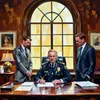



Detective Emilio Gonzalez watched Police Chief Warren Lancaster hang up the phone, the man's usually ruddy face now ashen. In fifteen years with Dallas PD, Emilio had never seen the chief look so shaken.
"That was the governor," Lancaster announced to the room of command staff. "Says we've got one hour to show significant progress on the Dealey Plaza homicide before the Texas Rangers take over."
The chief's eyes scanned the room before landing on Emilio, lingering there with what Emilio recognized as barely disguised resentment.
"Gonzalez," Lancaster said. "You and Short are lead on this."
Emilio kept his face neutral despite his surprise. He'd spent three years in Internal Affairs before transferring to Homicide, earning Lancaster's permanent animosity by investigating several of the chief's friends. William Short had his own history with the brass—a decorated detective who'd testified against a police lieutenant in a corruption case two years ago.
"Yes, sir," Emilio replied, already mentally cataloguing what he knew about the incident. The victim—still unidentified in official channels—had been lynched by protesters less than an hour ago. Social media was exploding with videos and accusations.
"The governor's sending a State Police liaison," Lancaster continued, his jaw tight. "They'll be here by morning. Until then, this is our case, and we're going to show results. I don't want the goddamn Rangers treating us like we can't handle our own city."
"Understood," Emilio replied. "We'll head to the scene now."
"Take whoever you need," Lancaster added. "This is now priority one for the department."
Fifteen minutes later, Emilio was driving through downtown with William Short in the passenger seat, both men in uncomfortable silence as they processed the politics surrounding this assignment.
"You know why he picked us, right?" Short finally said, his Alabama accent still prominent despite a decade in Texas.
"To set us up to fail," Emilio replied, turning onto Houston Street. Emergency vehicles still blocked access to Dealey Plaza, their lights flashing against the darkening evening sky.
"Or because we're the only ones he knows won't bury evidence even if it points somewhere uncomfortable," Short countered, nodding toward the police barricade ahead. "And that's about as uncomfortable as it gets."
Emilio parked behind the coroner's van and surveyed the scene. Yellow evidence markers dotted the plaza like malignant flowers. The iconic pergola and grassy knoll, famous from the Kennedy assassination, now bore witness to another public killing. A crowd of onlookers pressed against the police tape, many recording with their phones.
Most disturbing was the figure still suspended from the streetlight arm—a middle-aged man in business attire, his face discolored and distorted in death. Heat radiated from the nearby shell of a burned-out BMW, wisps of smoke still rising from its charred frame.
"Madre de Dios," Emilio muttered. Fifteen years on the force, eight in Homicide, and he'd never seen anything like this—a public lynching in the heart of Dallas.
"Medical examiner's been waiting for detectives before they cut him down," an officer explained as they approached. "Scene's been compromised by first responders and the fire crew that handled the vehicle fire, but we've been documenting everything."
"Witnesses?" Short asked, slipping on latex gloves.
"Hundreds," the officer replied. "Most left when it got violent, but we've been collecting contact information from everyone still here."
Emilio nodded. "What about the officers who were on scene when it happened?"
The officer's expression tightened. "Three of them are over there," he gestured toward a patrol car where three uniformed officers sat looking shell-shocked. "They were the first responders. Claim they were outnumbered."
"We'll talk to them," Emilio said. "First, let's get him down."
The medical examiner's team approached with a body bag. As they worked to release the victim from the makeshift noose, Emilio studied the man's face. Late forties or early fifties, Caucasian, well-dressed in what had been a button-down shirt and khakis. No wallet had been found in his pockets—either removed by the killers or lost in the struggle.
"Time of death?" Emilio asked the ME technician.
"Preliminary estimate is between 12:15 and 12:45 PM," she replied. "Cause appears to be asphyxiation from hanging, but we'll confirm in autopsy."
"Any ID?"
"Nothing on the body. Vehicle registration might help, but..." she glanced at the burned BMW.
"We'll run the VIN," Short said. "Fire doesn't destroy that."
As the body was lowered into the bag, Emilio traced the path from the burned vehicle to the streetlight—approximately thirty feet. Evidence markers showed blood drops along the way. He could piece together the basic sequence: victim pulled from car, dragged to the light, hanged. But the why and who remained elusive.
Short approached the BMW, careful to avoid the still-hot metal. "Fire looks deliberate," he noted. "Probably to destroy evidence."
"Or send a message," Emilio added.
A crime scene technician was photographing the rear of the vehicle. "Detectives, you might want to see this."
Emilio joined him, noting the partially burned bumper sticker: "It's OK to be whi—" The rest had melted away.
"Document it thoroughly," Emilio instructed. "And I want the VIN run immediately. Let's identify our victim."
Short was already examining the pavement nearby. "Shell casing," he called, pointing to an evidence marker. "Looks like 9mm."
"Consistent with the reports of a gunshot," Emilio noted. "Though no gunshot wounds on the victim from what I could see."
"Could be his weapon," Short suggested. "Reports said he had a gun."
"Let's not assume anything," Emilio replied, a mantra from his IA days. "Evidence only."
He turned his attention to the three officers sitting by the patrol car. Their body language spoke volumes—defensive postures, avoiding eye contact, the unmistakable tension of men who knew they were in trouble.
"I'm Detective Gonzalez," he began, showing his badge. "This is Detective Short. We need your account of what happened here."
The oldest of the three, a sergeant by his stripes, spoke first. "We've already given statements to patrol supervisors."
"Now you'll give them to the lead detectives," Short replied, his tone leaving no room for argument.
"Walk us through it," Emilio said. "From the beginning."
The sergeant—Anderson, according to his nameplate—sighed heavily. "We were assigned to monitor the protest. Started peaceful around 10 AM, maybe a hundred people with signs. By noon, it had grown to at least three times that, and some were getting agitated."
"What changed?" Emilio asked.
"Group of maybe twenty, twenty-five showed up all in black. Face coverings, backpacks. Started working the crowd up with chants about fascism and resistance."
"Antifa?" Short asked.
"They didn't identify themselves," Anderson replied carefully. "But same tactics, same gear."
The youngest officer, Rodriguez, added, "They hung an effigy of Trump from a tree. That's when things started to really escalate."
"Where were you positioned?" Emilio asked.
"Eastern edge of the plaza," Anderson said. "We were told to maintain visibility but not engage unless there was clear danger to persons or property."
"And when did you first notice the victim?"
The three officers exchanged glances.
"We heard the commotion," the third officer, Murphy, finally said. "Saw a crowd gathering around a vehicle on Elm. By the time we got there, they were already dragging him from the car."
"You didn't intervene?" Short's question carried an edge.
"We called for backup," Anderson defended. "There were three of us and at least fifty of them. Protocol is to wait for adequate resources before engaging a hostile crowd."
"While you waited," Emilio said, keeping his voice neutral, "they hanged a man."
"We detained an individual who was attempting to interfere," Rodriguez offered, as if this somehow balanced the scales.
Emilio's interest sharpened. "Someone tried to help the victim?"
"White male, early forties," Anderson confirmed. "He was running toward the crowd. Combative when we intercepted him. Claimed he knew the victim."
"Where is he now?"
"Central booking. Resisting arrest, assaulting an officer."
"I want his information," Emilio said to Short, who nodded and made a note.
"What about the protesters who put the rope around the victim's neck?" Emilio continued. "Any of them in custody?"
The silence was answer enough.
"So let me understand this," Emilio said, struggling to keep his professional demeanor. "You had time to arrest someone trying to help the victim, but not any of the people actually killing him?"
"They scattered as soon as he..." Murphy didn't finish the sentence.
"As soon as he died," Emilio completed it for him. "While you held down a potential witness."
Anderson's face hardened. "We followed protocol, Detective. You weren't there."
"No, I wasn't," Emilio agreed. "I'm here now, though, and I need the name of the man you arrested, plus a detailed description of anyone you saw participating in the assault and murder."
The sergeant's jaw worked silently for a moment before he answered. "Christopher Stannish. The guy we detained. He's in the system now."
"And the descriptions?"
"We'll provide what we can," Anderson said. "But most were masked."
"Most isn't all," Short interjected. "Start with the ones whose faces you saw."
As the officers began reluctantly providing details, Emilio's phone rang. The crime scene tech calling about the vehicle.
"We got an ID from the VIN," the technician said. "BMW is registered to John Foster. Address in North Dallas. Ran his license—white male, 53, matches our victim's general appearance."
"John Foster," Emilio repeated, writing the name in his notebook. "Any priors?"
"Clean record. Not even a parking ticket in the last five years."
"Next of kin?"
"Wife, Marissa Foster. Same address. Should be in the system."
Emilio thanked him and ended the call, turning to Short. "We have a tentative ID. John Foster, 53. Need to make next-of-kin notification."
Short nodded grimly. "I'll call it in, get officers to the residence."
"No," Emilio said. "We do it ourselves. This man deserves that much."
He turned back to the three officers. "I expect detailed written statements within two hours. Every face you saw, every word you heard. And I want the body cam footage from all three of you on my desk immediately."
"Most of it won't be usable," Anderson protested. "Too much movement, and—"
"All of it," Emilio cut him off. "Unedited. We'll determine what's usable."
As they walked back toward their car, Short let out a low whistle. "Lancaster's gonna have our badges if we go after those officers."
"Lancaster gave us this case because he thought we'd fail," Emilio replied. "But a man died today because those officers didn't do their job. I'm not sweeping that under the rug to make the chief happy."
Short smiled grimly. "That's why we're partners. You thinking what I'm thinking about this Christopher Stannish?"
Emilio nodded. "He might be our best witness. Let's talk to him after we notify the family."
"This is going to be bad, Emilio," Short said quietly. "The politics, the media, the racial component... it's a powder keg."
"I don't care about any of that," Emilio replied, starting the car. "John Foster was murdered in broad daylight by a mob. He gets justice regardless of who it offends."
As they drove away from Dealey Plaza, Emilio glanced in the rearview mirror at the scene still illuminated by emergency lights. More news vans had arrived, reporters doing stand-ups with the crime scene as a backdrop. The narrative was already being crafted by people with agendas, but Emilio had only one agenda—truth.
Whatever it cost him professionally, John Foster would get the investigation he deserved. Emilio made that silent promise as they headed north, toward a home where they would deliver the worst news imaginable to people who had no idea their lives had already been irrevocably shattered.