


John Foster blinked into consciousness, disoriented by the sudden absence of pain. The memory of struggling for breath, of desperate panic as the rope tightened, still echoed in his mind—but now there was only stillness and clarity.
He stood on a path of perfectly fitted hewn stones, winding upward through the most magnificent forest he had ever beheld. Ancient trees reached toward a sky of impossible blue, their leaves shimmering with gold and silver light. The air carried scents he recognized—cedar, pine, wildflowers—but with an intensity that made each breath feel like his first true inhalation.
"I'm dead," he whispered, the words neither fearful nor sad, simply an acknowledgment of truth.
The forest around him seemed to respond, a gentle breeze stirring the canopy in what felt almost like confirmation. John glanced down at himself, surprised to see he wore not the business clothes he'd died in, but a simple white tunic and pants. His hands, which had been scraped and bloody during his struggle, were now whole and unmarked.
The path ahead beckoned. Without conscious decision, John began to climb, each step feeling lighter than the last. The dappled light through the trees played across the stones, creating patterns that seemed almost like writing—messages he could almost, but not quite, decipher.
He had walked perhaps five minutes when he sensed rather than heard someone join him. Turning, John felt his heart swell with recognition.
"Dad?"
Thomas Foster walked beside him, appearing exactly as John remembered him before cancer had claimed him fifteen years earlier—robust, clear-eyed, his weathered face creased with the subtle smile that had always been his hallmark. He wore simple clothing similar to John's.
"You're here," John said, his voice thick with emotion.
Thomas didn't speak but placed a hand on John's shoulder, the touch conveying more than words ever could. The warmth and solidity of it dispelled any notion that this might be illusion or dream.
They continued upward together, the path growing steeper. Around another bend, a third figure awaited them—John's grandfather, William Foster, who had passed when John was just twelve. The old man's eyes crinkled with familiar affection as he fell into step on John's other side.
Three generations of Foster men climbed in companionable silence. John felt questions rising—where exactly were they going? Why couldn't his guides speak? What awaited him?—but they dissolved before reaching his lips. There was a rightness to this moment that made questions seem unnecessary, even intrusive.
As they ascended, the forest thinned, giving way to alpine meadows dotted with flowers John had never seen before—blossoms that seemed to glow from within, colors shifting subtly as they passed. The stone path remained, now bordered by low walls of white marble.
John became aware of music—or something like music—emanating from all around them. Not sound exactly, but a harmonic vibration that resonated through his being, growing stronger as they climbed. The melody carried elements of every beautiful piece he'd ever heard, yet remained entirely new and otherworldly.
The path made a final turn, and John stopped, transfixed by what lay before him.
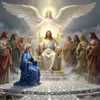
They had reached the mountain's summit, which opened into a vast circular space paved with stones that gleamed like opals. At the center stood a great throne of living light, so brilliant that John should have been blinded, yet he could perceive it clearly.
Upon this throne sat a figure whose countenance John somehow knew without seeing clearly—Jesus Christ, appearing simultaneously as the humble carpenter of Nazareth and the King of all creation. To His left stood a woman of indescribable grace and beauty, her blue mantle shimmering with stars. Mary, the Mother of God, whose gentle eyes seemed to look directly into John's soul.
Surrounding them in a semicircle were thirteen figures that John instinctively recognized as saints, though he couldn't name them all. They sat as if in judgment, their faces solemn yet compassionate.
Above this assembly hovered a being of pure light, with wings that appeared to span the entire width of the summit—an angel whose presence filled John with both awe and trembling.
Understanding washed over him like a wave. This was no welcome committee; this was judgment. The Tribunal of Heaven had convened to assess his life, to weigh his soul.
John's father and grandfather gently guided him forward, stopping at a respectful distance from the throne. Then, with final reassuring touches to his shoulders, they stepped back, leaving John to stand alone before the assembly.
The weight of every sin, every failure, every moment of weakness throughout his life suddenly pressed down upon John's consciousness. Not imposed from without, but rising from within—his perfect memory in this place denied him the comfort of forgotten transgressions. He saw his life with brutal clarity: moments of casual cruelty to Marissa when work stress overwhelmed him; opportunities to help others that he'd ignored out of selfishness; the pride he'd taken in his business success while attributing others' struggles to lack of effort; the times he'd allowed anger to override mercy.
The accumulated weight drove him to his knees. He bowed his head.
"Lord," John said, his voice barely audible even to himself, "I am not worthy."
He had been raised Catholic, had believed intellectually in judgment and mercy, but now, faced with the reality of divine perfection, his lifetime of half-hearted devotion seemed pathetically inadequate. How could his occasional Sunday masses and perfunctory prayers outweigh a life that, while not evil, had fallen so far short of what it could have been?
No accusations came from the throne. No voice enumerated his failings. It wasn't necessary—John's own conscience provided all the condemnation required.
"I have no defense," he continued, eyes fixed on the gleaming stones beneath him, unable to raise his gaze to the throne. "I've failed more often than I've succeeded. I've loved imperfectly. I've judged others harshly while excusing myself. I built things of metal and precision while neglecting what truly matters."
John found himself reciting a lifetime of specific sins, the words pouring out in a spontaneous confession unlike any he'd ever made. It was excruciating yet somehow cleansing, like lancing a wound that had festered for decades.
When he finally fell silent, John waited for the judgment he was certain would follow—the declaration that he was unworthy of paradise, that he would be cast down to suffer the consequences of his failures.
In this moment of desperation, John remembered his mother's devotion to the Virgin Mary, how she'd taught him to ask for the Mother's intercession in times of greatest need. Without raising his head, he directed his thoughts toward the gentle figure at Christ's side.
'Holy Mother,' he prayed silently, 'I don't deserve your help, but please speak for me. Not because I'm worthy, but because you are merciful.'
A hush fell over the assembly. John sensed rather than saw Mary turn toward her Son, a wordless communication passing between them. The light from the throne intensified, washing over John in waves that seemed to penetrate every fiber of his being.
Still kneeling, John finally found the courage to raise his eyes. Jesus was looking directly at him with an expression of such perfect understanding that John felt simultaneously exposed and embraced. Those eyes knew everything—every thought, every intention, every moment of John's existence—yet held no condemnation, only a love so powerful it defied comprehension.
Mary's gentle gaze also rested upon him, her expression one of infinite compassion. She gestured subtly toward her Son, a movement that somehow conveyed both advocacy and acceptance of whatever verdict would follow.
Jesus rose from the throne, His form both substantial and luminous, and approached John. The assembly of saints watched in reverent silence as Christ extended His hand toward the kneeling man.
"John Foster," Jesus spoke, His voice resonating not just in John's ears but throughout his entire being, "you have judged yourself more harshly than I would judge you. You see only your failures; I see also your goodness, your attempts to rise after falling, your love for your family, the times you chose right though it cost you."
Christ's hand reached out, not to help John rise but to rest upon his head in blessing. "Your journey is not complete. There is work yet unfinished in a world growing darker by the day."
Confusion rippled through John. "But I died," he whispered. "They killed me."
"Your death serves a purpose," Jesus continued, "but so too may your return. My faithful ones still labor in a world that increasingly rejects them. They need courage. They need hope. They need witnesses."
Mary stepped forward then, standing at her Son's side. "You called to me in faith," she said, her voice like gentle music. "I have asked for this chance for you."
"Chance?" John echoed, struggling to comprehend.
The angel above them descended slightly, its radiance intensifying as it spoke. "The remnant of believers faces persecution unlike any since the early Church. They are ridiculed, marginalized, and now, increasingly, threatened with violence. They need one who has passed through death to remind them of what awaits beyond it."
A vision opened before John—glimpses of faithful Christians gathering in homes rather than churches, praying in secret, losing jobs and standing because they refused to compromise their beliefs, children mocked in schools for their parents' faith. He saw how thin the line was becoming between social ostracism and physical danger.
"If I am sent back," John asked, "what would be my purpose?"
"To be a messenger to the remnant," Jesus answered. "To strengthen those who waver. To remind them that I have not abandoned them though the world grows dark. To show by your return that I am still Lord even over death."
"You will speak to those with ears to hear," one of the saints added. "Your testimony will give courage to the faithful when they face their own trials."
"I wasn't strong in faith when I lived," John admitted. "I was a Sunday Catholic at best. Why me?"
"Because your death has placed you at the center of attention," Mary explained gently. "Your voice will reach where others cannot. And because your very ordinariness will testify that God works through imperfect vessels."
"The Adversary believes he has claimed a victory in your death," the angel said. "He believes the fear it has sown will silence many more believers. Your return would turn his victory into defeat."
Jesus extended both hands now, palms up. "But first, three trials await you, John Foster. Three opportunities to demonstrate the faith you will ask others to hold. The Adversary will oppose you, seeking to keep what he believes is already his."
"I'm not strong enough," John said, the enormity of such a mission overwhelming him.
“You will be in our thoughts but you must face The Adversary alone,” Mary assured him. “You must prove your commitment to your Lord through the trials."
Jesus's expression grew more solemn. "Do you accept this mission, John Foster? Not because it will earn your salvation—that was secured long ago by My sacrifice—but because the remnant of My people needs hope in an evil time.”
John looked from Christ to Mary, then to the assembled saints whose expressions conveyed both encouragement and solemn warning. This was no small thing being offered. Not just life restored, but purpose defined—to be a living testimony to people struggling to maintain faith in a world increasingly hostile to it.
He thought of Marissa and his sons, how they too were part of this remnant, how they would face their own trials in the aftermath of his death. Could his return strengthen not just them but others like them?
"I accept," John said, the words feeling like a vow etched into the fabric of his soul.
Jesus nodded, satisfaction in His eyes. "Then rise and prepare. The Adversary approaches for the first trial."
The assembly of saints stood in unison, forming a protective circle around John as the angel above them raised its wings, creating a dome of light that encompassed the summit.
The air grew suddenly colder. The perfect blue sky darkened as if a storm approached, but no natural storm carried such a sense of concentrated malevolence. John felt it—a presence of such profound wrongness that his very being recoiled.
"Remember," Jesus said, His voice both gentle and commanding, "the Adversary cannot take what is not surrendered. Stand firm in faith."
The light from the throne intensified around John as the darkness pressed closer, and he felt himself being prepared for something beyond his understanding—a spiritual battle for which his earthly life had been merely preparation.
Whatever came next, John knew with sudden clarity that the outcome would depend not on his strength but on his choice. Would he surrender to fear or stand in faith? Would he trust the promise of the One who had already conquered death?
As the darkness gathered itself for the first assault, John Foster straightened his shoulders and faced it squarely, ready to begin the trials that would determine whether he would return as a messenger of hope to the faithful remnant in an increasingly faithless world.