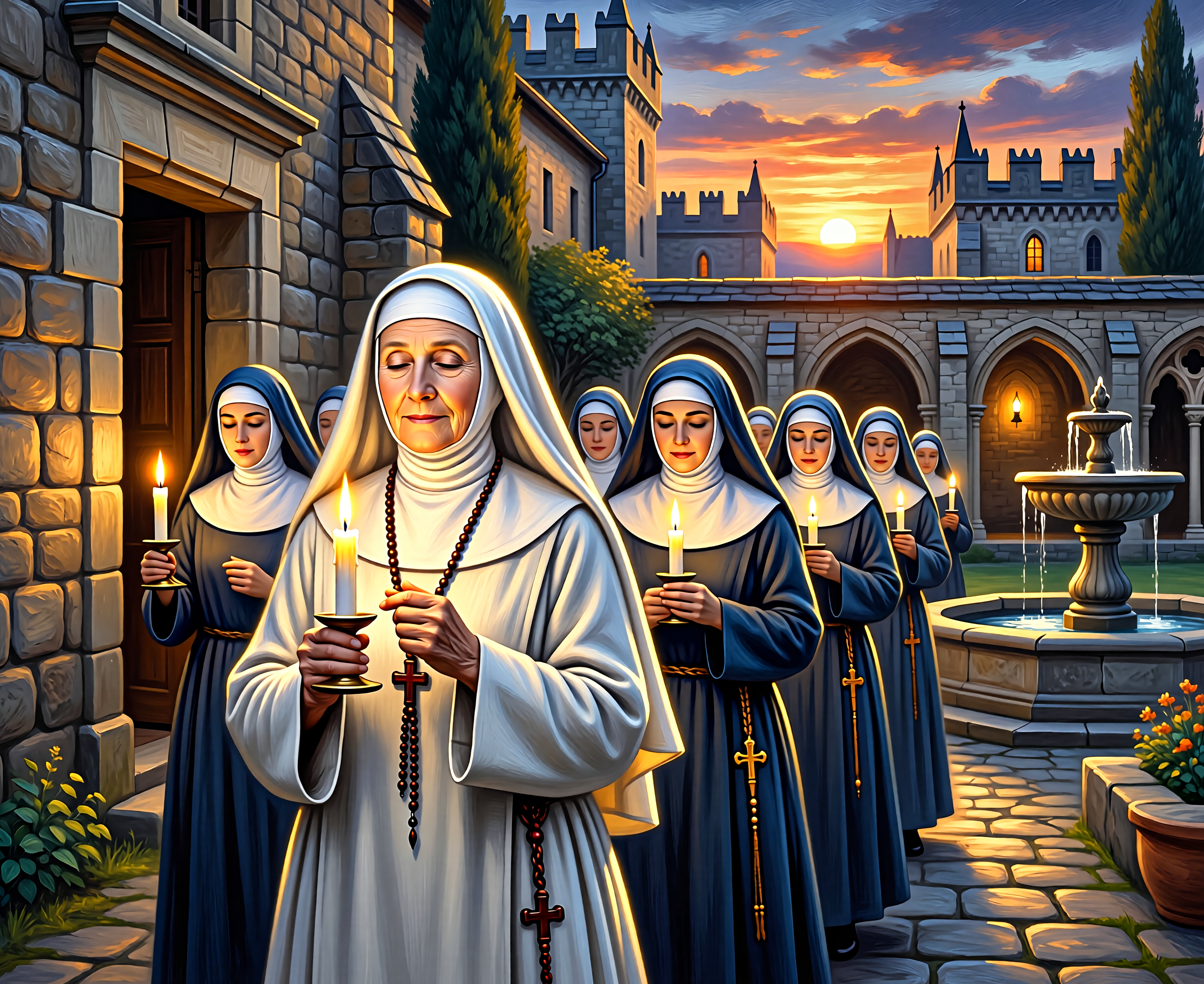











































































































Sister Margaret Mary Catherine knelt in the chapel of the Convent of the Sacred Heart in Dallas, her weathered hands clutching rosary beads worn smooth by decades of prayer. At seventy-three years of age, she had witnessed profound changes within the Catholic Church, but nothing had prepared her for the unprecedented decision Mother Superior had made the previous evening.
For the first time in the convent's eighty-year history, all forty-two sisters had gathered in the community room to watch a live stream on the large television normally reserved for papal addresses and major feast day celebrations. The occasion was the second night of John Foster's ministry event at Robber Baron Stadium, barely ten miles from their cloistered walls.
Sister Margaret Mary had initially resisted the idea of watching what she considered a television preacher, but the supernatural events of the previous evening—reports of every television and electronic device in the region being overtaken by the broadcast—had convinced Mother Superior that they were witnessing something of divine significance that demanded their attention.
Now, as the sisters filed quietly into the community room for the 7:00 PM broadcast, Sister Margaret Mary felt an unusual mixture of anticipation and apprehension. The television screen displayed the interior of the massive stadium, with its distinctive stage setup and the thousands of empty seats that would soon fill with seekers and believers.
Mother Superior, a woman of seventy whose sharp intellect had guided the convent through decades of ecclesiastical upheaval, stood before the assembled sisters. "My daughters, we gather tonight not as spectators but as witnesses. If God is indeed speaking through this man, then we must have ears to hear, regardless of denominational boundaries."
As the broadcast began and John Foster took his position at the podium, Sister Margaret Mary was struck by the prophet's bearing—humble yet authoritative, speaking with the measured cadences of sacred scripture rather than the emotional manipulation she associated with television preachers.
"Hear now the words of the Lord concerning the great falling away that has come upon the Church in these latter days," John Foster declared, his voice carrying supernatural authority that seemed to penetrate directly into Sister Margaret Mary's soul. "Behold, what was foretold by the apostle Paul has come to pass: 'Let no one deceive you by any means; for that Day will not come unless the falling away comes first.'"
Sister Margaret Mary felt her breath catch as the prophet's words struck her with the force of divine revelation. She had spent decades watching the slow corruption of institutions she had once revered, but had never heard anyone articulate the spiritual battle with such clarity.
"The modern Church in the West stands at a crossroads, though many of its congregants appear blissfully unaware that they have already chosen a wide and easy path to destruction. What passes for Christianity in this generation would be unrecognizable to the Church Fathers, incomprehensible to the medieval scholastics, and abhorrent to the Reformers."
Around her, Sister Margaret Mary could hear the sharp intake of breath from her fellow sisters as John Foster's condemnation cut through decades of comfortable compromise and willful blindness.
"We are witnessing nothing less than the attempted replacement of Christianity with its heretical doppelganger: Churchianity, a false gospel that elevates worldly concerns above spiritual ones, that replaces timeless Biblical authority with the dynamic narrative of secular politics, and that transforms the Church from a beacon of eternal truth into an echo chamber for earthly ideologies."
Sister Margaret Mary thought of the endless committee meetings, the social justice workshops, the climate change initiatives that had gradually consumed more and more of the Church's energy and resources while traditional devotions and catechesis were quietly abandoned or marginalized.
"Most damning of all," the prophet continued, "this apostasy represents the complete inversion of Christianity's fundamental premise: instead of being in the world but not of it, the false church insists on being entirely of the world while maintaining an increasingly unconvincing veneer of theological legitimacy."
The words hit Sister Margaret Mary like physical blows as she recognized the accuracy of Foster's diagnosis. She had watched her own order gradually transform from a community dedicated to prayer, penance, and service to God into something that resembled a secular social work organization with religious window dressing.
"This is not merely another doctrinal dispute in the long history of theological debate," John Foster declared, his voice rising with prophetic fire. "This is apostasy wearing a clerical collar, heresy draped in liturgical vestments, and blasphemy proclaimed from ten thousand pulpits every Sunday morning."
Sister Margaret Mary glanced at Mother Superior, whose face had grown pale but whose eyes remained fixed on the screen with intense concentration.
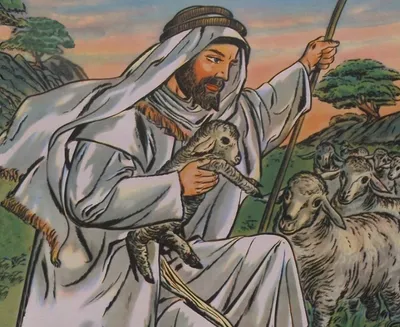
"The tragedy is not that wolves have entered the sheepfold—Jesus Christ himself warned us they would come. The tragedy is that the sheep now bleat in self-righteous pride as they are led astray by those who seek to destroy them."
John Foster's analysis grew more specific as he dissected the mechanism of theological corruption: "Take any Biblical command, strip it of its soteriological context, and reinterpret it through the lens of contemporary social justice politics. 'Love thy neighbor' ceases to be about individual charity and becomes a mandate for policies that destroy Christian civilization. 'Care for the poor' transforms from personal almsgiving into advocacy for programs that enslave souls to dependency. 'Welcome the stranger' transforms from basic hospitality into a divine command to facilitate the demographic replacement of Christian nations."
Sister Margaret Mary remembered the endless diocesan directives about immigration, climate change, and social justice that had increasingly dominated their community's discussions while prayer time was reduced and traditional devotional practices were quietly discouraged as "outdated" or "divisive."
"This hermeneutical vandalism does violence not only to individual verses, but to the entire Biblical narrative," the prophet continued. "The God who destroyed Sodom and Gomorrah, who commanded His people to maintain their distinctiveness among the nations, who confused the languages at Babel to create separate peoples—this God is reimagined as a cosmic social worker whose primary concern is ensuring equal outcomes across all demographic categories."
The prophet's condemnation grew more pointed as he addressed specific denominations: "The Roman Catholic Church, which for centuries stood as a bulwark against heresy, now finds itself led by clerics who are more concerned about climate change than the salvation of souls. The current occupant of Peter's throne speaks more passionately about carbon emissions than abortion, more forcefully about income inequality than sexual morality, and far more frequently about migrants than martyrs."
Sister Margaret Mary felt tears streaming down her face as John Foster spoke truths she had recognized but never heard articulated with such prophetic authority. Around her, she could see several sisters weeping openly while others sat in stunned silence.
"The Church that once launched the Crusades to defend Christendom now declares it a moral imperative to welcome those who would see every cross destroyed and every cathedral burned to the ground."
The prophet's condemnation extended to Protestant denominations: "The mainline Protestant churches have fared even worse. They compete to see who can more thoroughly repudiate their theological heritage in favor of sexual perversion and moral relativism. These churches have hemorrhaged members not because Christianity is dying, but because this false gospel offers nothing that cannot be found in a political party."
John Foster's voice softened slightly as he addressed the tragedy of the situation: "Even the evangelical churches, which initially resisted this insidious corruption, have begun to succumb. Pastors discover that sermon series on 'social justice' fill more seats than expositions on the book of Romans. Youth leaders find that endorsing anti-Christian movements provides them with more social cachet than leading Bible studies."
As the first portion of the sermon concluded, and a band began to play a religious rock ballad, Mother Superior stood before her sisters, many of whom were visibly shaken by what they had heard. "My daughters, we have heard hard truths tonight. Let us examine our own hearts and our own community to see where we have allowed the spirit of this age to compromise our commitment to the eternal Gospel of Jesus Christ."
When the broadcast ended well after 9PM, Sister Margaret Mary remained kneeling as her fellow sisters filed out to evening prayer, her mind reeling from the prophetic indictment she had just witnessed. For decades, she had felt increasingly isolated as a faithful Catholic surrounded by clergy and religious who seemed more interested in secular politics than eternal salvation.
Tonight, she had heard God's prophet speak the truth she had carried silently in her heart—that what passed for Christianity in the modern world was often a counterfeit that led souls away from rather than toward the narrow path of salvation. The great apostasy was not coming; it had already arrived, and only those with eyes to see could recognize the spiritual battle raging within the very institutions that claimed to represent Christ on earth.