



























































































































John Foster continued his exposition from the podium, his voice carrying the weight of divine authority as he traced the thread of God's providence through Israel's restoration and preparation for the coming Messiah.
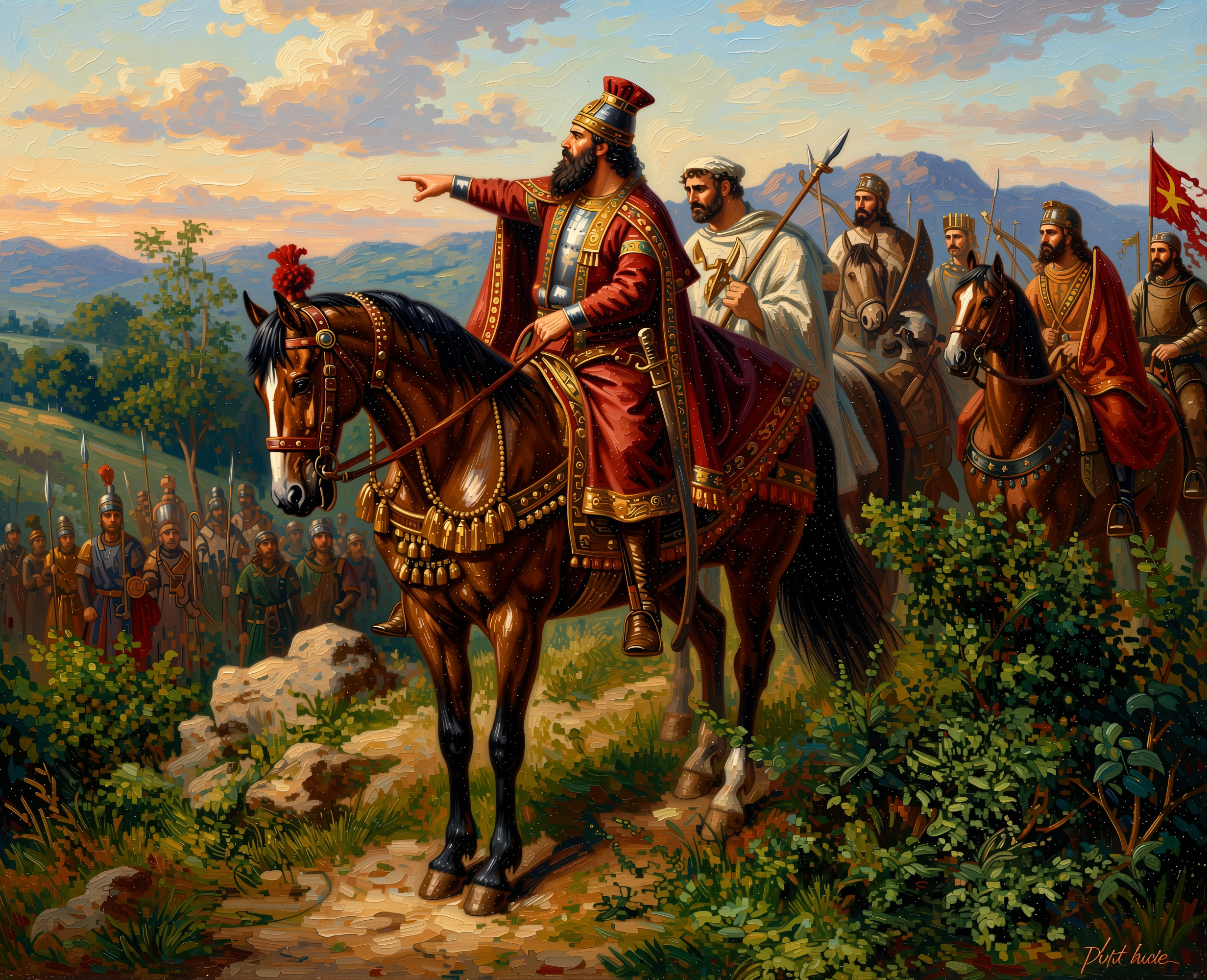
"Behold, in the first year of Cyrus king of Persia, that the word of the Lord by the mouth of Jeremiah might be fulfilled, the Lord stirred up the spirit of Cyrus king of Persia, so that he made a proclamation throughout all his kingdom and also put it in writing, saying: 'Thus says Cyrus king of Persia: All the kingdoms of the earth the Lord God of heaven has given me. And He has commanded me to build Him a house at Jerusalem which is in Judah.'"
The prophet's voice carried wonder at the divine orchestration of earthly powers:
"Who is among you of all His people? May his God be with him, and let him go up to Jerusalem which is in Judah, and build the house of the Lord God of Israel—He is God—which is in Jerusalem. Moreover, the king commanded that the vessels of gold and silver of the house of God, which Nebuchadnezzar had taken from the temple which is at Jerusalem and carried to Babylon, should be restored and taken back to the temple which is at Jerusalem, each to its place; and you shall put them in the house of God."
John's exposition emphasized the divine provision for the restoration:
"Then the heads of the fathers' houses of Judah and Benjamin, and the priests and the Levites, with all whose spirits God had moved, arose to go up and build the house of the Lord which is in Jerusalem. And all those who were around them encouraged them with articles of silver and gold, with goods and livestock, and with precious things, besides all that was willingly offered."
The prophet described the rebuilding with both joy and sorrow:
"And they sang responsively, praising and giving thanks to the Lord: 'For He is good, for His mercy endures forever toward Israel.' Then all the people shouted with a great shout, when they praised the Lord, because the foundation of the house of the Lord was laid. But many of the priests and Levites and heads of the fathers' houses, old men who had seen the first temple, wept with a loud voice when the foundation of this temple was laid before their eyes. Yet many shouted aloud for joy, so that the people could not discern the noise of the shout of joy from the noise of the weeping of the people, for the people shouted with a loud shout, and the sound was heard afar off."
John's voice carried prophetic significance as he described the second temple's spiritual emptiness:
"Yet when the temple was completed and dedicated with great ceremony, the glory of the Lord did not fill the house as it had filled Solomon's temple. The Shekinah glory, the visible presence of the Almighty that had dwelt between the cherubim above the mercy seat, did not return to sanctify this second temple. The Holy of Holies remained empty, a testimony that God's presence had departed from Israel because of their sins."
The prophet's exposition moved through the intertestamental period with its political upheavals:
"In the days of Antiochus Epiphanes, that wicked king of Syria, the temple was defiled with pagan sacrifices, and an image of Zeus was set up in the holy place. The daily sacrifice was taken away, and swine's flesh was offered upon the altar of burnt offering. Then arose Mattathias the priest and his five sons, called the Maccabees, who led a revolt against the Syrian oppressors and cleansed the temple from its defilement."
John described the religious parties that emerged from this period:
"From these struggles arose two great parties among the Jews: the Sadducees, who controlled the temple and the priestly offices, being worldly men who collaborated with whatever foreign power ruled over them, caring more for political advantage than spiritual truth; and the Pharisees, who became the teachers of the law among the people, adding tradition upon tradition to the commandments of God, until they made the word of God of no effect through their traditions."
The prophet's voice carried condemnation for both parties:
"The Sadducees denied the resurrection of the dead, the existence of angels, and the coming of Messiah, being materialists who sought only temporal power and wealth. The Pharisees, though they believed in resurrection and the coming kingdom, bound heavy burdens upon the people, grievous to be borne, while they themselves would not move them with one of their fingers. They made long prayers for a pretense, and devoured widows' houses, and for this cause they received greater damnation."
John's exposition took a profound turn as he addressed the transformation of Israel's language:
"Hear now a mystery that few have understood: during the seventy years of Babylonian exile, the children of Israel lost their Hebrew tongue, the sacred language in which the Lord had spoken to their fathers. When they returned from captivity, they spoke Aramaic, the language of their captors, and could no longer understand the scriptures when read in the original Hebrew."
The prophet's voice carried divine judgment in this linguistic transformation:
"This was no accident, but a judgment of the Almighty upon His people for their rebellion and apostasy. As they had forsaken the words of the Lord spoken in Hebrew, so the Lord caused them to forget the Hebrew tongue, that they might know their separation from their covenant heritage."
John described the miraculous preservation of scripture through translation:
"Yet the Lord in His mercy provided a means by which His word might be preserved and proclaimed to all nations. In the days of Ptolemy Philadelphus king of Egypt, the Lord moved upon seventy learned scribes to translate the Hebrew scriptures into Greek, the common tongue of the civilized world. This translation, called the Septuagint, became the authorized version of God's word, blessed by divine providence and confirmed by miraculous agreement among the translators."
The prophet's voice carried prophetic significance in this linguistic shift:
"And when this Greek translation was completed and accepted by the Jewish communities throughout the world, the Lord allowed the original Hebrew manuscripts to perish, signifying that He had transferred His covenant from those who spoke Hebrew to those who would receive His word in whatever tongue He chose to reveal it. For God is not bound by human languages, but speaks in every tongue to those who have ears to hear."
John emphasized the spiritual significance of this transformation:
"By the time of the Roman dominion over Judaea, Hebrew had become a dead language, known only to the priests and scribes for ceremonial purposes. The common people spoke Aramaic in their daily discourse, while Greek served as the lingua franca of the Roman Empire, the tongue of commerce, learning, and governance throughout the Mediterranean world."
The prophet's exposition reached toward its climactic purpose:
"Thus did the Lord prepare the world for the coming of His Son, ensuring that the gospel would be proclaimed not in the narrow confines of Hebrew particularism, but in the universal language of Greek, that all nations might hear and understand the message of salvation. The confusion of tongues at Babel was reversed at Pentecost, when the apostles spoke in every language under heaven, proclaiming the wonderful works of God."
John's voice carried messianic expectation as he described the spiritual condition of Israel at the time of Christ's birth:
"When the fullness of time had come, God sent forth His Son, born of a woman, born under the law, to redeem those who were under the law, that we might receive the adoption as sons. The virgin Mary conceived by the Holy Spirit and brought forth a son, and they called His name Jesus, for He would save His people from their sins."
The prophet's description of Christ's ministry emphasized its revolutionary nature:
"Jesus of Nazareth came preaching the kingdom of heaven, speaking in Aramaic to the common people and in Greek to the learned, for He was master of every tongue. He taught not in Hebrew, the dead language of a dead covenant, but in the living speech of those whom He came to save. Yet the religious leaders, bound to their traditions and their dead language, could not receive Him."
John's voice carried both sorrow and triumph as he described the crucifixion:
"The chief priests and Pharisees delivered Him to Pontius Pilate, saying, 'We have no king but Caesar,' thus renouncing their covenant with the God of their fathers. They chose Barabbas the murderer over Jesus the Savior, and cried out, 'His blood be on us and on our children.' And Pilate, washing his hands before the multitude, delivered Jesus to be crucified."
The prophet's voice rose with resurrection power:
"But death could not hold the Prince of Life. On the third day He rose from the dead, appearing first to Mary Magdalene, then to the other women, then to Peter, then to the twelve, and after that to above five hundred brethren at once. He showed Himself alive after His passion by many infallible proofs, being seen of them forty days, and speaking of the things pertaining to the kingdom of God."
John concluded this portion of his message with the Great Commission:
"And Jesus came and spoke to them, saying, 'All authority has been given to Me in heaven and on earth. Go therefore and make disciples of all the nations, baptizing them in the name of the Father and of the Son and of the Holy Spirit, teaching them to observe all things that I have commanded you; and lo, I am with you always, even to the end of the age.'"
The prophet paused, having traced the divine preparation for the gospel through Israel's exile, return, linguistic transformation, and spiritual preparation. The stage was now set for his exposition of how these ancient patterns would illuminate the condition of modern Judaism and its relationship to the Christian gospel.
The empty stadium remained silent except for the sound of his voice, but millions around the world hung upon every word as John Foster prepared to apply these historical truths to contemporary realities.