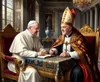










The personal secretary to His Holiness sat quietly in the corner of the ornate conference room within the Apostolic Palace, his practiced hands taking careful notes as the most significant theological discussion of his fifteen-year tenure unfolded before him. The mahogany table reflected light from crystal chandeliers while Renaissance frescoes gazed down upon five men whose decisions would determine the Catholic Church's response to the most controversial religious phenomenon of the modern era.
The Pope occupied the head of the polished table with the serene bearing that had characterized his pontificate, yet today carried obvious tension about addressing claims that challenged the very foundations of contemporary ecclesiastical authority. The Congregation for the Doctrine of the Faith had requested this emergency consultation after reports from three continents documented supernatural demonstrations that demanded an official Vatican response.
The Bishop of Fort Worth sat to the Holy Father's right, his modest demeanor reflecting the pastoral simplicity that had earned respect throughout his Texas diocese. Across from him, the Archbishop of São Paulo maintained the diplomatic composure expected of prelates governing major metropolitan archdioceses, while the Archbishop of Paris displayed visible agitation about events that had humiliated French governmental authority.
The secretary understood that this meeting would determine whether the Catholic Church embraced or condemned John Foster, the American businessman whose claimed resurrection and prophetic calling had generated unprecedented supernatural demonstrations while triggering international governmental opposition. The ecclesiastical implications extended far beyond individual evaluation to fundamental questions about divine intervention in contemporary affairs.
His Holiness opened the discussion by reading directly from documentation that had been compiled by Vatican intelligence services monitoring Foster's ministry throughout three countries. The Pope's voice carried measured authority as he quoted the American prophet's most challenging condemnation of Church leadership:
"Hear now the word of the Lord concerning those who claim to speak in His name but serve the powers of darkness. Behold, there are shepherds who feed themselves but do not feed the sheep. They have made themselves servants of mammon, bowing down before the altars of worldly power and political expediency."
The secretary felt the room's atmosphere grow heavier as the Pope continued Foster's systematic indictment: "The leaders of the visible Church have become harlots, selling themselves to the highest bidder among the princes of this world. They speak not the words of Christ but the slogans of those who seek to destroy Christian civilization itself."
The most controversial portion of Foster's Dallas sermon struck directly at contemporary Church immigration positions: "They have made themselves zealous proponents of the great replacement, the deliberate destruction of Christian nations through indiscriminate immigration and the erasure of godly culture. What they call mercy is in truth an instrument of judgment upon the faithful, a sword wielded by enemies of the cross to destroy the inheritance of centuries."
The Pope's reading concluded with obvious gravity about the implications of such systematic condemnation delivered with apparent supernatural authority: "What are we to make of this prophet who condemns our shepherding while demonstrating power that suggests divine commissioning?"
The Bishop of Fort Worth responded first, producing a substantial document that dominated the table space before him. "Your Holiness, I present extensive documentation compiled by Father Giuseppe Fortini, who serves as spiritual advisor to John Foster and believes beyond all doubt that this man is a consecrated Prophet of God."
The thick report represented months of careful observation and testimony collection that the secretary recognized as thorough ecclesiastical investigation rather than hurried evaluation. The Bishop continued: "Father Fortini has documented numerous miraculous healings, supernatural demonstrations, and prophetic revelations that appear to exceed human capability or technological explanation."
Opening the report to selected passages, the Bishop cited specific examples: "Verified restoration of paralyzed limbs, healing of terminal cancers, and the supernatural fire barriers that have protected Foster's ministry from hostile forces. Multiple medical professionals have confirmed healings that transcend scientific explanation."
The secretary noted the Bishop's obvious conviction as he concluded: "Based on this comprehensive evidence and Father Fortini's spiritual discernment, I believe John Foster is a genuine Prophet of God whom the Catholic Church should recognize as such. His harsh words about ecclesiastical corruption may reflect divine judgment rather than human criticism."
The Archbishop of Paris responded with barely contained hostility that reflected the governmental humiliation his nation had suffered during Foster's ministry. "Your Holiness, I must respectfully but firmly disagree with my brother Bishop's assessment. John Foster is a sophisticated charlatan who uses advanced technology to create illusions of supernatural power."
The French prelate's analysis reflected extensive investigation by his diocesan staff and French intelligence services: "The fire barriers surrounding his venues are pyrotechnic displays using directed energy weapons, while his global broadcast capabilities result from massive cybersecurity breaches that penetrate electronic devices worldwide."
The secretary observed the Archbishop's increasing agitation as he presented his conspiracy theory: "Most significantly, Foster's technical infrastructure operates from Russian servers near Moscow, suggesting coordination with Russian intelligence services and the Russian Orthodox Church to undermine papal authority and Catholic unity."
The accusation of foreign manipulation carried serious implications that extended beyond theological evaluation into geopolitical conspiracy that could explain governmental opposition throughout Europe. The Archbishop concluded: "I believe Foster represents a calculated attack on the See of Rome using religious deception to promote schism and political instability."
The Archbishop of São Paulo offered measured analysis that sought middle ground between his colleagues' opposing positions: "Your Holiness, my experience with Foster's Brazilian ministry suggests neither complete acceptance nor total rejection is appropriate without further investigation."
The Brazilian prelate's diplomatic approach reflected extensive experience managing complex ecclesiastical situations: "While I cannot dismiss the documented supernatural phenomena surrounding Foster's ministry, his systematic condemnation of Church leadership raises serious concerns about pride and judgmental spirit incompatible with authentic prophecy."
The secretary appreciated the Archbishop's nuanced theological analysis that addressed both evidential and pastoral considerations: "I recommend the Church issue canonical admonition inviting Foster to repent of harsh criticism against ecclesiastical authority or defend his accusations when he arrives in Rome for his scheduled ministry event."
The proposal offered a traditional ecclesiastical process that would enable formal evaluation while providing Foster opportunity to respond to official concerns about his prophetic claims and criticism of Church leadership.
His Holiness listened carefully to all three presentations before announcing his decision with papal authority that would determine the Catholic Church's response to the most significant prophetic phenomenon since the Fatima apparitions. The secretary recognized this moment as historically significant regardless of the eventual outcome.
"We shall proceed with canonical admonition as recommended by our brother Archbishop of São Paulo," the Pope declared with measured finality. "John Foster will be formally invited to defend his prophetic claims and address his criticisms of Church leadership during his planned Roman ministry."
The decision reflected papal wisdom that avoided premature condemnation while establishing formal process for evaluating supernatural claims that could not be dismissed without proper investigation. The secretary understood that Foster's response would determine whether the Catholic Church embraced or rejected the most controversial religious figure of the contemporary era.
"Prepare formal documentation requiring Foster's appearance before the Congregation for the Doctrine of the Faith during his Roman visit," the Pope instructed while the secretary made careful notes about unprecedented proceedings. "We shall determine whether his ministry is prophetic and if his criticisms reflect divine judgment or human pride through canonical examination."
The meeting concluded with understanding that Foster's ministry had created unprecedented challenges for ecclesiastical authority while demonstrating supernatural power that demanded serious theological evaluation rather than political dismissal.
As the assembled prelates departed, the secretary reflected on witnessing historic deliberations that would determine the Catholic Church's relationship with prophetic authority claiming divine mandate to reform institutional corruption through supernatural demonstration and uncompromising truth-telling that challenged comfortable assumptions about contemporary ecclesiastical leadership.
The canonical admonition would either validate Foster's prophetic calling through successful defense of his ministry or expose him as prideful critic lacking divine authority to condemn shepherds appointed by apostolic succession to guide the universal Church through complex modern challenges requiring pastoral wisdom rather than prophetic condemnation.